

Table of Contents
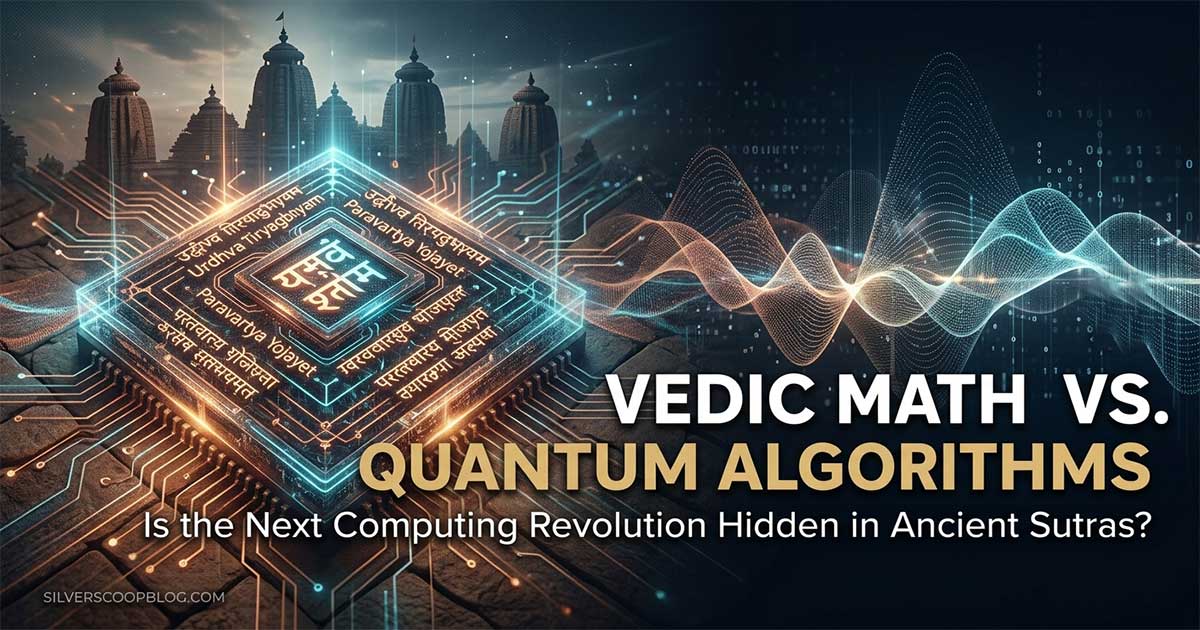
Vedic Math vs. Quantum Algorithms: Is the Next Computing Revolution Hidden in Ancient Sutras?
As we move into 2026, the global race for “Quantum Advantage” has hit a physical wall: Decoherence and Error. While IBM and Google scale physical qubits into the thousands, the energy cost of classical error correction is skyrocketing.
But what if the solution to 21st-century quantum noise was written 3,000 years ago?
The emerging field of Vedic Computing is no longer a fringe theory. Top research institutions in India and Europe are now analyzing whether the logic of ancient Indian Sutras the pithy, aphoristic formulas of Vedic Math can provide a more efficient architecture for quantum gates and cryptographic security.
1. The “Urdhva Tiryagbhyam” Multiplier in Silicon & Qubits
The most famous Vedic formula, Urdhva Tiryagbhyam (Vertically and Crosswise), is already a legend in VLSI (Very Large Scale Integration) design. In 2026, this isn’t just for calculators; it’s being tested in Quantum Arithmetic Units (QAUs).
- The Logic: Unlike traditional Greek-based multiplication that requires multiple steps, Vedic multiplication is inherently parallel.
- The Quantum Win: Quantum computers thrive on parallelism. By implementing Vedic multipliers in quantum circuits, researchers are seeing a significant reduction in “gate depth” meaning fewer operations and, crucially, less time for the fragile qubits to lose their state (decoherence).
2. Quantum Error Correction: The “Paravartya” Shift
Quantum computers are notoriously “noisy.” In 2026, the biggest challenge is Quantum Error Correction (QEC). Conventional methods require hundreds of physical qubits to create one reliable “logical” qubit.
Researchers are now looking at the Paravartya Yojayet sutra (Transpose and Apply). In classical algebra, this is used for synthetic division. In the quantum realm, it is being adapted for Iterative Decoding in error-correcting codes. By simplifying the feedback loop of error detection, Vedic logic could theoretically lower the “Qubit Overhead” that currently plagues the industry.
3. Cryptography: Vedic Number Theory vs. Shor’s Algorithm
The tech world is currently bracing for “Q-Day” the moment a quantum computer breaks RSA encryption. While the world hunts for “Post-Quantum Cryptography” (PQC), the answer might lie in the unique number theory of the Vedas.
- The “Neti Neti” Logic: The Upanishadic principle of “neither this nor that” bears a striking resemblance to quantum superposition.
- Vedic Cryptography: New 2026 startups in Bengaluru and Indore are developing encryption algorithms based on Vedic Modular Arithmetic. These are proving to be more resilient to Shor’s Algorithm because they don’t rely solely on the “prime factorization” vulnerability that classical RSA does.
4. The “Braj” Perspective: Why Consciousness Matters
Following the Silver Scoop philosophy, we must look at the “Social Arbitrage” of this trend. The region of Braj (Vrindavan/Mathura) has been a center for Sanskrit logic (Nyaya) for centuries.
As we build Agentic AI and Physical Robotics, the Western “Binary” view (0 or 1) is failing to capture human-like nuance. Vedic logic, which allows for “multi-valued” states of existence, is a more natural fit for the Probabilistic Logic required by the 2027 generation of AI robots.
5. The “Bhubaneswar Blueprint” Connection
Just as Bhubaneswar is winning the GCC race, it is also becoming a hub for Computational Indology. With IIT Bhubaneswar leading research in “Knowledge Systems,” we are seeing the first Vedic Quantum Coprocessors being prototyped. This isn’t just about heritage; it’s about building a uniquely Indian tech stack that is faster, cooler (thermally), and more efficient.
The Verdict: A Hybrid Future
The next computing revolution isn’t a choice between “Ancient” and “Modern.” It is a Hybrid Architecture. By 2027, the most powerful computers on earth may well be using Quantum Hardware running Vedic Software Logic.
For the digital professional, the message is clear: To understand the future of the “Invisible Internet,” you might need to look back at the original blueprints of human thought.
Recommended Readings: 7 Spatial Computing Trends That Will Replace Your Laptop by 2027 | Generative Urbanism: Can AI Design a Neighborhood with Soul?
– https://silverscoopblog.com/generative-urbanism-15-minute-city-neighborhood-soul/
“Is the future of tech written in the past? Leave a Comment for the Silver Scoop ‘Braj Dispatch’ for more intersections of culture and code.”
“Are you a founder, creator, or seeker living in the Braj region? Reach out to us – we want to tell your story in the next Dispatch.”
Consult with Us at – SilverScoopBlog Contact
FAQs’
Q: Is Vedic Math actually used in modern computers?
A: Yes. Vedic multipliers are frequently used in Digital Signal Processing (DSP) and FPGA designs because they are faster and use less power than traditional Booth multipliers.
Q: Can Vedic logic help with AI?
A: Absolutely. The multi-valued logic systems found in ancient Indian texts are highly compatible with Fuzzy Logic and Probabilistic AI models being developed for 2026.
Q: Is “Vedic Computing” a recognized field?
A: It is a growing interdisciplinary field. In 2025-2026, several papers were published on “Vedic Computing in Quantum Algorithms,” focusing on speed, scalability, and error correction.
Have any thoughts?
Share your reaction or leave a quick response — we’d love to hear what you think!
-
 0
0
-
 2
2
-
 0
0
-
 0
0
-
 0
0
-
 0
0

1 comment
Move forward this Discussions
Awaited for your valuable feedback/comment