

Table of Contents
By mid-2026, we have solved the speed problem. We have solved the scale problem. But we are still wrestling with the Certainty Problem. As LLMs (Large Language Models) have integrated deeper into our SaaS workflows and personal lives, they have become eerily good at being wrong with confidence. In the industry, we call them Hallucinations. But as these models become more sophisticated, these hallucinations aren’t just “fake facts” they are subtle logical deviations that can derail a $10M project or a life-altering career move.
Against this backdrop, an ancient technology is making a comeback: Human Intuition. Here is why your “Gut” is the final frontier of high-stakes decision-making.
1. The Hallucination Paradox: Polished Inaccuracy
In 2026, AI doesn’t just “lie”; it extrapolates based on probabilistic patterns.
- The Danger: Because the output is grammatically perfect and logically structured, our “System 1” brain (the fast, instinctive one) tends to accept it as truth.
- The Reality: AI lacks Ontological Grounding. It knows that “A follows B,” but it doesn’t know what “A” feels like in the real world. This is where the hallucination hides in the gap between data patterns and physical reality.
2. Somatic Markers: The Science of “The Gut”
What we call “Intuition” is actually the Somatic Marker Hypothesis. Neuroscientist Antonio Damasio posits that our brains store the “emotional flavor” of past experiences in our bodies.
- The Mechanism: When you face a decision, your ventromedial prefrontal cortex triggers a “gut feeling” a physical sensation (tightness, warmth, or a “ping”) before your conscious mind even processes the data.
- The Advantage: Your gut is a high-bandwidth processor of context that AI cannot access. It remembers the subtle “vibe” of a failed partnership or the “scent” of a market bubble that isn’t yet reflected in the data points.
3. The 2026 “Vibe Check”: Why Founders are Pivoting
Following the Silver Scoop philosophy of Digital Minimalism, many founders are now using AI to generate options but using “Vibe Checks” to select them.
- Agentic Filtering: You might use an AI agent to scout 50 locations for your next Reverse Migration office, but you choose the one that “feels right” when you step onto the sandstone floors.
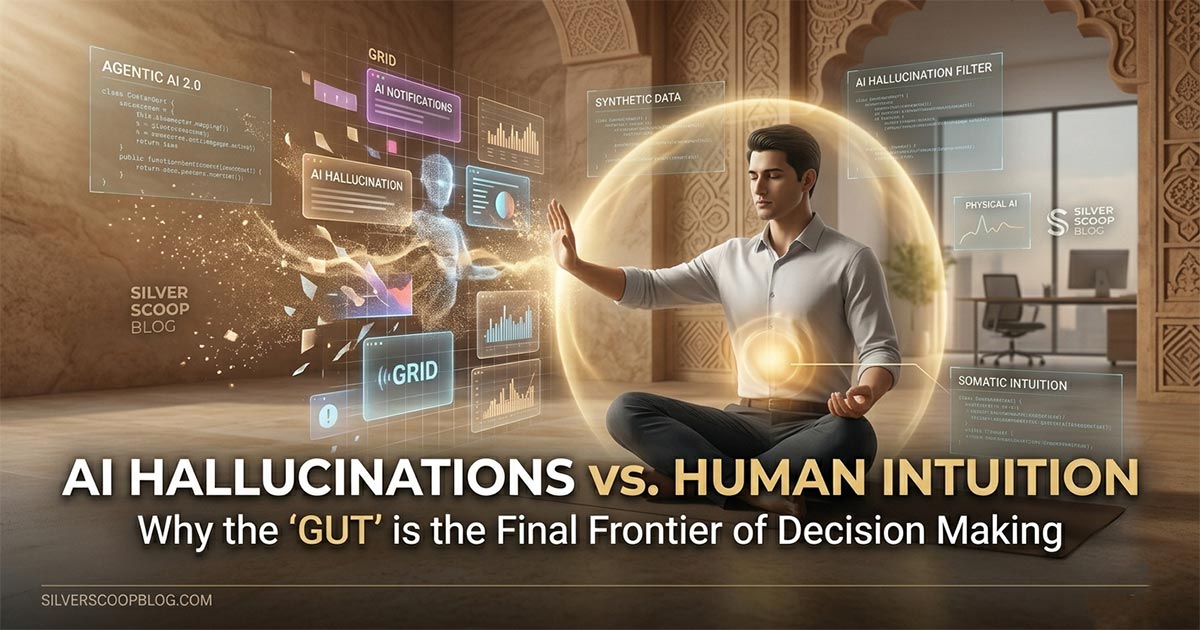
- The Failsafe: Intuition acts as the ultimate Hallucination Filter. If the AI-generated strategy looks perfect on paper but gives you a “sinking feeling,” 2026 leadership dictates you listen to the feeling.
4. Training Your Intuition in an AI World
If you spend 12 hours a day in a spatial headset, your “Gut” goes offline. To keep your intuition sharp, you need Analog Calibration.
- The “Optic Flow” Reset: Practices like the Vrindavan Digital Fast are essential. By moving through the physical world without digital prompts, you allow your somatic markers to recalibrate.
- The Quiet Hour: To hear your intuition, you must silence the “Ambient AI.” This is the cornerstone of Deep Work 2.0.
The Human-AI Decision Matrix
| Feature | AI Logic (LLM) | Human Intuition (The Gut) |
| Speed | Milliseconds | Instant (Subconscious) |
| Data Source | Global Internet Training | Personal Lived Experience |
| Failure Mode | Hallucination (Logical) | Bias (Emotional) |
| Best For | Synthesis & Drafts | Final Selection & Ethics |
The Verdict: The Sovereign Decision-Maker
The goal of 2026 is not to replace AI with intuition, but to integrate them via the Human-AI Contract. Use AI for the computation, but retain the sovereignty of the final call.
In a world of synthetic certainty, your gut is the only thing that is truly yours. Don’t ignore it.
FAQs’
Q: Why do AI hallucinations happen?
A: Hallucinations occur because LLMs predict the next most likely token in a sequence based on probability, not necessarily based on factual truth or real-world physics.
Q: Can intuition be wrong?
A: Yes. Intuition can be clouded by cognitive biases or past trauma. This is why 2026 leadership involves “Triangulating” checking AI data against human logic and gut feeling.
Q: How can I improve my gut feeling?
A: Lowering systemic stress through NSDR and regular Digital Fasts allows the body’s internal signaling system (the gut-brain axis) to function without electronic interference.
Have any thoughts?
Share your reaction or leave a quick response — we’d love to hear what you think!
-
 1
1
-
 1
1
-
 0
0
-
 1
1
-
 0
0
-
 0
0