

Table of Contents
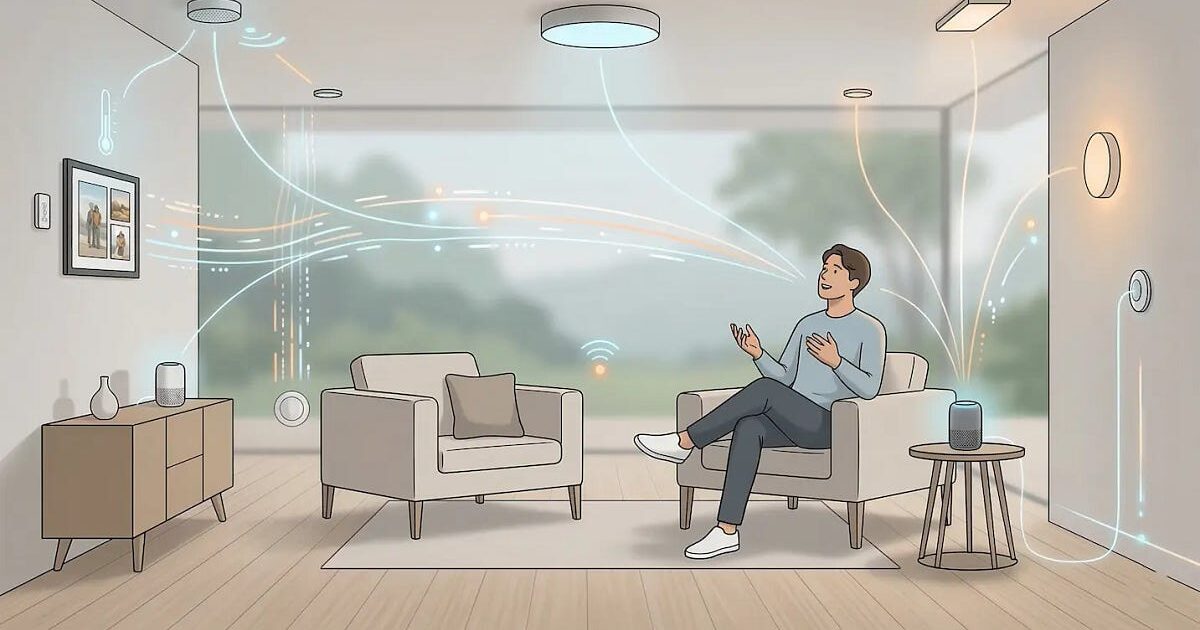
In 2026, the most sophisticated technology in your home is the one you never see. We have moved past the “Silicon Cage” of managing dozens of disconnected apps and shouting commands at smart speakers. Instead, we have entered the age of Ambient Computing a future where technology recedes into the background, operating through an “invisible interface” that senses, learns, and anticipates our needs.
This is more than automation; it is Cognitive Sovereignty through environmental intelligence.
1. The Invisible Interface: Technology That Disappears
Ambient computing represents a shift from active technology engagement to passive intelligent environments. In 2026, your home doesn’t wait for a command; it uses Multimodal AI to interpret context from your biometrics, behavior, and environment.
- Presence over Power: Lights don’t just turn on; they adjust their color temperature based on your circadian rhythm and the current cloud cover outside.
- Embedded Intelligence: Screens are hidden under wood or plaster, only appearing when your presence suggests you need information.
- Natural Interaction: Traditional UIs are replaced by gesture recognition and natural language processing that understands your intent, not just your words.
2. The Matter Standard: A Universal Language
The friction of 2024 where devices from different brands refused to talk has been solved by the universal adoption of Matter.
- Unified Ecosystems: In 2026, your alarm clock, window blinds, and coffee machine operate as a single, coordinated system regardless of the manufacturer.
- Local Processing: To reduce latency and increase privacy, 2026 systems process data locally on the edge rather than sending every motion trigger to the cloud.
- Multi-Admin Control: You can manage your home simultaneously through Apple, Google, or specialized Sovereign Tech hubs without complex re-pairing.
3. Anticipatory Living: Real-World 2026 Scenarios
Ambient computing moves from “reactive” to “proactive,” effectively acting as a digital butler that clears your cognitive load.
- The Health Sentinel: Your bathroom mirror analyzes your skin tone for signs of nutrient deficiency, while your bed sensors detect sleep apnea before you wake up feeling tired.
- The Energy Optimizer: As solar production peaks at noon, your home automatically shifts energy-heavy tasks like laundry or car charging to maximize self-sufficiency.
- The Workflow Anchor: When you enter your home office, the Architecture of Silence is activated notifications are suppressed, and your “Focus Zone” lighting is engaged based on your calendar.
4. The Ethics of the “Always-On” Home
With total convenience comes the risk of total surveillance. In 2026, the elite are prioritizing Privacy by Design.
- Federated Learning: Your home learns your habits locally, ensuring your private data never leaves your personal server to train a corporate AI.
- Physical Cut-offs: High-tech homes now include physical “kill-switches” for microphones and cameras to ensure absolute privacy when needed.
- Data Sovereignty: Users have granular control over what data is collected, how long it is stored, and who can access it.
The Verdict: Reclaiming Your Attention
The ultimate promise of Ambient Computing isn’t to give you more gadgets; it’s to give you back your attention. By removing the friction of routine tasks, your home allows you to focus on creativity, connection, and Deep Work.
The smartest home is the one that knows when to get out of your way.
FAQs’
Q: Does Ambient Computing require a total home renovation?
A: No. In 2026, modular systems like Yubii OS allow you to layer ambient intelligence onto existing smart devices through software updates and Matter-certified bridges.
Q: Is ambient tech safe from hackers?
A: By 2026, most ambient systems utilize Zero-Trust Architecture, requiring continuous verification for every device and process on the network.
Q: Can I turn off the “anticipation” features?
A: Yes. Human-centric design in 2026 mandates that users must be able to toggle off predictive features or revert to manual control at any time.
Have any thoughts?
Share your reaction or leave a quick response — we’d love to hear what you think!
-
 0
0
-
 0
0
-
 0
0
-
 0
0
-
 0
0
-
 0
0