

Table of Contents
To continue our exploration of the 2026 landscape for SilverScoopBlog, we turn our gaze toward the horizon, literally. The way we design, build, and inhabit our cities is undergoing an algorithmic revolution.
AI-Generated Architecture: How Algorithms are Drafting the Next Great Cities
For decades, the skyline of a city was the signature of a human master Le Corbusier’s concrete grids, Zaha Hadid’s sweeping curves, or Frank Gehry’s deconstructivist metal. But in 2026, the most innovative architectural “signatures” are being written in code.
Welcome to the era of Generative Urbanism. We are moving away from the architect as a “Geometry Creator” and toward the architect as a “System Orchestrator.”
1. Beyond the Blueprint: What is Generative Design?
In traditional drafting, an architect draws one version of a building. In Generative Design, they define the “Fitness Criteria.”
The constraints are the new ink:
- Solar Optimization: “Maximize natural light for every apartment while minimizing heat gain in summer.”
- Wind & Microclimate: “Arrange the towers to prevent ‘wind tunnels’ at the street level.”
- Carbon Sequestration: “Use the least amount of high-carbon concrete by optimizing structural loads.”
The AI engine (using tools like Autodesk Forma or TestFit) then “breeds” thousands of iterations, evolving the best-performing designs in seconds. In 2026, we aren’t just looking for the prettiest building; we are looking for the most efficient environmental machine.
2. 15-Minute Cities: Drafting the Social Fabric
The “Next Great Cities” of 2026 aren’t just about glass and steel; they are about Walkability. AI is being used to realize the 15-Minute City concept neighborhoods where work, health, and play are within a 15-minute walk or bike ride.
Researchers at Tsinghua University and urban hubs like Singapore are using AI-driven simulations to:
- Analyze Pedestrian Flow: Predicting how people move to place parks and shops in the most accessible spots.
- Smart Zoning: Dynamically adjusting land use based on real-time population data rather than 50-year-old static master plans.
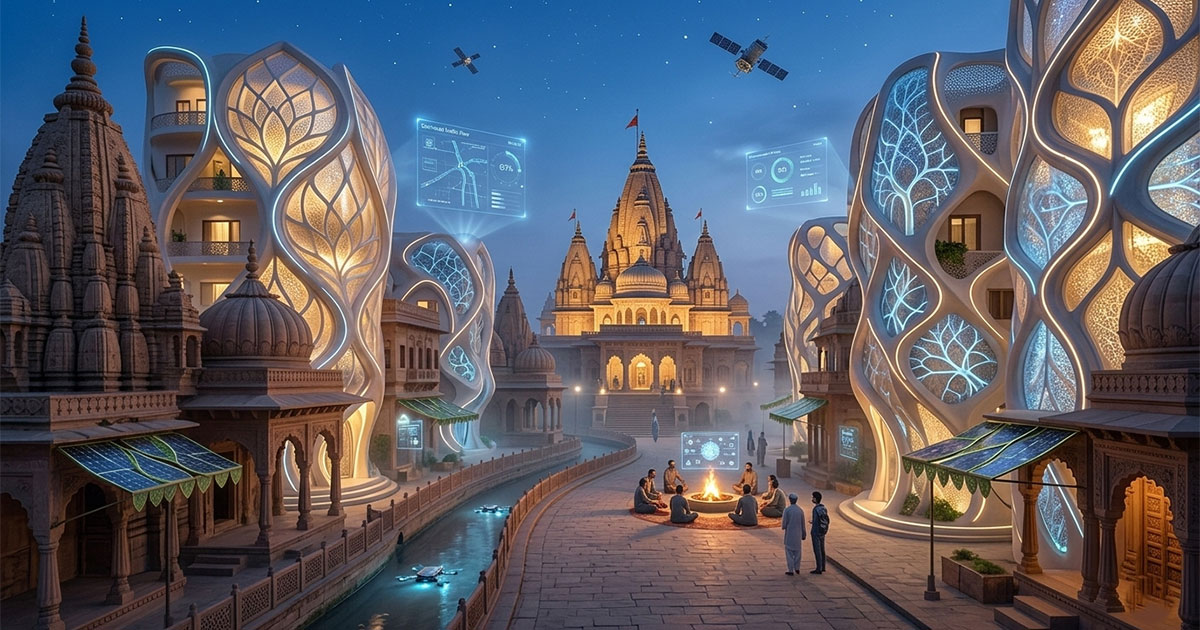
- The “Vrindavan” Influence: Much like our focus in The Braj Dispatch, AI is helping heritage cities integrate high-density modern housing without destroying the “sacred geometry” and cultural flow of ancient streets.
3. Digital Twins: The Cities That Breathe
A city in 2026 is never “finished.” Through Digital Twin technology, every physical building has a live, data-driven replica.
- Predictive Maintenance: AI sensors detect a structural micro-crack or a water leak years before it becomes a failure.
- Energy Sector Coupling: In cities like Copenhagen, AI coordinates building heating, EV charging, and renewable grids in real-time, essentially turning the entire city into a giant, breathing battery.
4. The Human Edge: Will AI Replace the Architect?
The short answer: No. But it is replacing the repetitive labor of architecture. By automating code compliance, plumbing routing, and structural calculations, AI frees human architects to focus on what algorithms lack: Empathy, Culture, and Vibe.
In 2026, the best architecture firms aren’t the ones with the most powerful computers, but the ones who can most effectively “speak” to the AI to ensure the resulting city feels human-centric.
The Verdict: The Algorithmic Renaissance
The cities of the future will be more complex than anything we’ve seen, yet they will feel more natural. By using AI to solve the “math” of sustainability and density, we are finally free to design for the soul.
FAQs
Q: Is AI-generated architecture safe?
A: Yes. AI tools in 2026 are programmed with “Automated Code Compliance,” ensuring that every generated iteration meets or exceeds safety, fire, and structural standards before a human even reviews it.
Q: How does AI help with sustainable building?
A: AI optimizes for “Material Efficiency” using the least amount of steel or concrete possible. It also runs real-time solar and thermal simulations to reduce a building’s lifetime energy consumption by up to 40%.
Q: What is a 15-minute city?
A: It is an urban planning model where all essential services (grocery, school, work, clinic) are reachable within a 15-minute walk or bike ride, a layout increasingly designed by AI for maximum efficiency.