
In the early 2010s, success was defined by responsiveness. The faster you replied to an email, the more “important” you were. But as we move through 2026, the pendulum has swung violently in the opposite direction.
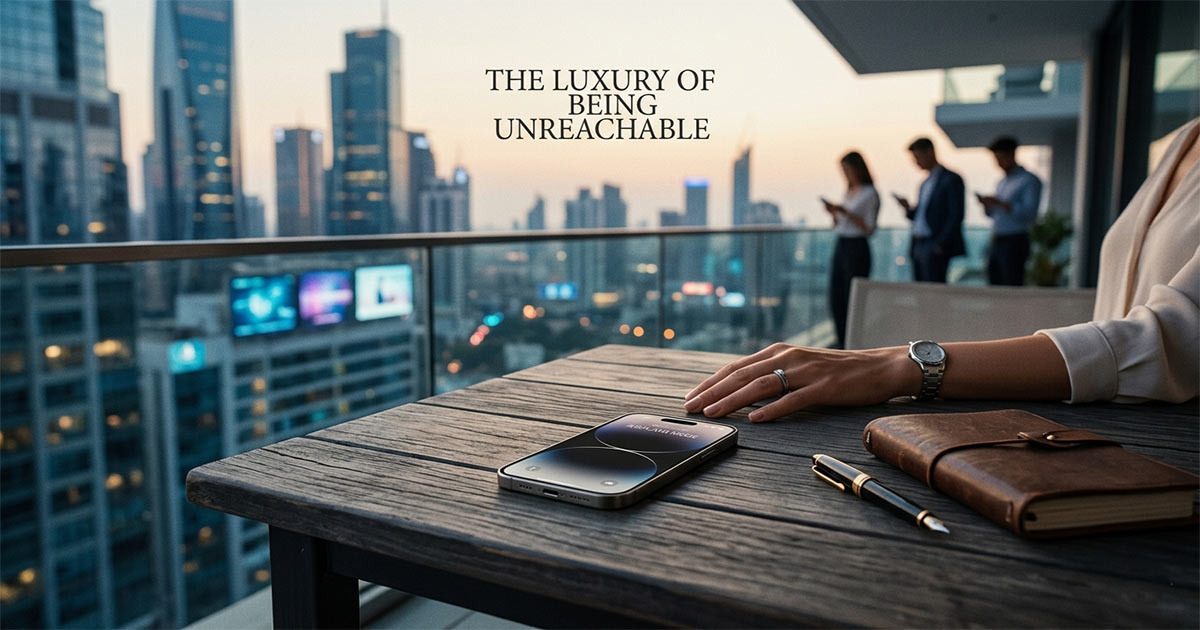
Today, the ultimate flex isn’t a blue checkmark or a 24/7 Slack presence. It is the ability to vanish. In a world of infinite connectivity, unavailability is the new Ferrari.
Read here – The Analog Status Symbol – Why Disconnectedness is the new trend?
The Great Digital Divergence
We are witnessing a “class split” in how we consume technology. For the majority, digital life is a mandatory stream of notifications, algorithmic feeds, and “always-on” expectations. But for the global elite, the founders, the deep-thinkers, and the high-performance 1% – silence has become a premium commodity.
Data from late 2025 suggests that “content diets” and digital restriction have moved from wellness trends to high-status signals. Just as organic, “clean” eating became a marker of the health-conscious wealthy, “clean attention” is now the hallmark of the successful professional.
Why Silence is the Ultimate Power Move
Why has “Airplane Mode” become such a potent status symbol? It boils down to three core pillars of modern luxury:
1. Proof of Autonomy
If you have to answer every WhatsApp message within five minutes, you aren’t the boss; the device is. The truly powerful have built systems and teams that allow them to step away. Being unreachable is a public declaration that your time is governed by your own priorities, not someone else’s ping.
2. The Cognitive “Deep Work” Advantage
Biohackers and elite performers have realized that constant “micro-context switching” is the enemy of Fluid Intelligence. By toggling Airplane Mode, the 1% are protecting their most valuable asset: their focus.
“The luxury of 2026 isn’t a faster processor; it’s the mental bandwidth to think three years ahead while everyone else is reacting to the last three minutes.”
3. Privacy as the New Exclusivity
In an era where every moment is logged, tracked, and sold, the act of “opting out” is a luxury. High-net-worth individuals are increasingly moving toward “analog journeys” using dumbphones (like the Mudita Kompakt), carrying physical “analog bags,” and attending digital-detox retreats where Wi-Fi is intentionally non-existent.
How to Cultivate “Unreachable Luxury” (Without Losing Your Edge)
You don’t need a private island to reclaim your attention. You can start “luxuriously” protecting your time today:
- The “Digital Sunset”: Turn off all screens 90 minutes before sleep. Not for “rest,” but to reclaim your internal narrative.
- Selective Availability: Move your critical communications to “Asynchronous Only.” Train your network that you respond on your schedule, not theirs.
- The Weekend Blackout: Treat Saturday and Sunday as “Signal-Free Zones.” Engage in tactile, analog hobbies reading physical books, vinyl records, or gardening.
- Hardware Minimalism: Consider a secondary “minimalist” device for deep-work hours that only supports calls and core utilities.
The Verdict: The Future is Analog
As AI-generated content floods our feeds and attention becomes the most scarce resource on the planet, those who can selectively disconnect will lead.
The 1% aren’t just buying time; they are buying presence. In 2026, the most sophisticated thing you can do is put your phone in a drawer, turn on Airplane Mode, and simply exist.
FAQs’
Q: Why has “Airplane Mode” become a status symbol in 2026?
A: It signals high-level autonomy. Only those who have built resilient systems or possess significant “time-wealth” can afford to be unreachable. It shifts the power dynamic from being “on-call” to being “in-control.”
Q: Does being unreachable hurt professional productivity?
A: Quite the opposite. By blocking out the “noise” of constant notifications, high-performers engage in Deep Work, allowing them to solve complex problems and think strategically tasks that “always-on” responsiveness actually hinders.
Q: What is the “Analog Renaissance” mentioned in the post?
A: It is a movement toward physical, tactile experiences such as using paper journals, vinyl records, or “dumbphones” as a luxury response to the oversaturation of digital and AI-generated content.
Q: How can I start practicing digital minimalism without disappearing?
A: Start with “Selective Availability.” Set specific windows for checking comms and use “Focus Modes” to whitelist only essential contacts, gradually training your network to respect your deep-work hours.
Have any thoughts?
Share your reaction or leave a quick response — we’d love to hear what you think!
-
 0
0
-
 1
1
-
 0
0
-
 0
0
-
 0
0
-
 0
0