

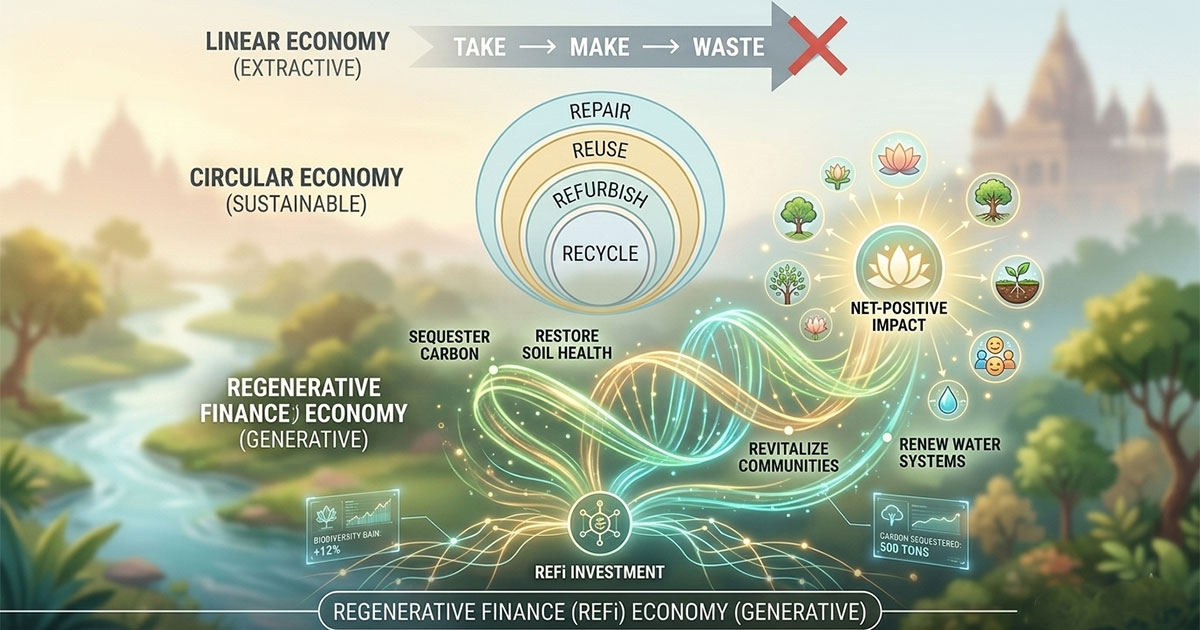
Sustainable finance is shifting. In 2026, the industry is moving past “ESG compliance” (which often simply means doing less harm) toward Regenerative Finance (ReFi) a model where companies are engineered to be net-positive.
Regenerative Finance: Investing in Companies that Give Back More Than They Take
For the last decade, the gold standard of ethical investing was ESG (Environmental, Social, and Governance). But as we navigate 2026, investors have realized a hard truth: merely slowing down the destruction of our planet isn’t enough. We need to actively repair it.
Enter Regenerative Finance (ReFi). This isn’t just about sustainability; it’s about Restoration. It’s the difference between a company that reduces its carbon footprint and one that is designed to actively sequester carbon, restore soil health, and revitalize local communities.
1. What is Regenerative Finance (ReFi)?
While traditional finance is “Extractive” taking raw materials and human labor to generate centralized profit, ReFi is “Generative.” It views capital as a tool to improve the health of the entire system.
The Three Pillars of a Regenerative Company:
- Net-Positive Impact: The company’s core operations leave the environment or society better than they found it.
- Circular Resource Loops: Waste is non-existent because every byproduct is a nutrient for another part of the system.
- Steward-Ownership: In 2026, we see a rise in Steward-Owned companies legal structures that prioritize the company’s mission over short-term shareholder dividends.
2. ReFi vs. ESG: Why the “S” is Being Replaced
In 2026, many institutional investors are moving away from traditional ESG scores because they lack “Real-World Proof.”
- ESG is about Risk Management: “Will this oil spill hurt my stock price?”
- ReFi is about Value Creation: “How much biodiversity did this agricultural project create this quarter?”
As noted in recent reports from Forbes Finance Council (2026), regenerative strategies are becoming a necessity to protect portfolios against “Systemic Instability” the economic shocks caused by climate change and resource scarcity.
3. High-Growth ReFi Sectors to Watch in 2026
If you are looking to align your portfolio with the “Vrindavan Edge” of ethical growth, keep an eye on these three sectors:
A. Regenerative Agriculture & Soil Tech
Companies like Biome Makers are using AI and DNA soil analytics to help farmers restore the “living” quality of their land. These companies don’t just sell fertilizer; they sell yield resilience. Healthy soil holds more water, sequesters more carbon, and requires fewer chemical inputs.
B. Natural Capital & Biodiversity Credits
Just as Carbon Credits dominated the 2010s, Biodiversity Credits are the breakout asset class of 2026. Startups like Symbiose Management are using satellite LiDAR and AI to generate high-precision biodiversity credits that companies buy to fund the restoration of specific forests and oceans.
C. Green Asset Tokenization
The “Machine” is meeting the “Monk” in the world of On-Chain ReFi. Platforms like ClimateKick are tokenizing renewable energy projects, allowing retail investors to own a “fraction” of a solar farm in the UAE or a reforestation project in the Braj region, providing liquid capital to projects that were once only for the ultra-wealthy.
4. The Investor’s Checklist: Finding the “Real” ReFi
How do you spot a truly regenerative company in a sea of “Greenwashing”?
- Look for Externalities: Does the company account for its “Scope 3” impact?
- Check the Governance: Are the workers and the local environment represented on the board?
- Analyze the “Why”: Does the company’s profit grow because the environment is getting healthier, or despite it?
The Verdict: The Future is Net-Positive
In 2026, the most profitable companies aren’t the ones that took the most they are the ones that were the best at giving back. Investing in ReFi isn’t just a “good deed”; it is the most sophisticated form of risk-adjusted, long-term wealth building available today.
Recommended Reading: Generative AI for Personal Finance: Beyond ChatGPT – https://silverscoopblog.com/generative-ai-personal-finance-tools/
FAQs
Q: What is the main difference between ESG and ReFi?
A: ESG focuses on mitigating harm and compliance, whereas ReFi focuses on active restoration and creating a net-positive impact on the planet and society.
Q: Are regenerative companies as profitable as traditional ones?
A: In the long term, yes. By building resilience against climate risks and reducing dependence on increasingly scarce raw materials, regenerative companies often have more stable margins and higher “Brand Equity” in 2026.
Q: What is “Steward-Ownership”?
A: It is a legal structure where the company is “owned” by its purpose. Profits are reinvested into the mission or shared with stakeholders, rather than being drained by external shareholders seeking short-term gains.
Have any thoughts?
Share your reaction or leave a quick response — we’d love to hear what you think!
-
 0
0
-
 1
1
-
 0
0
-
 0
0
-
 0
0
-
 0
0