

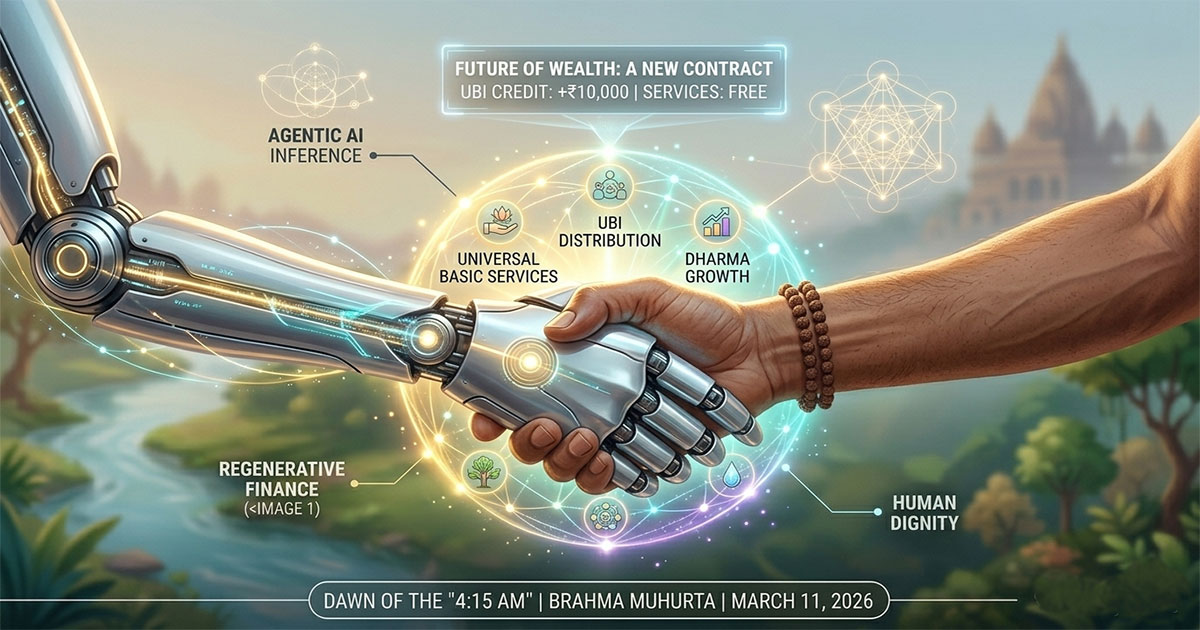
The 2026 economic landscape is facing a “Great Decoupling.” As Agentic AI begins to handle complex project management and SaaS operations tasks once reserved for highly skilled humans the conversation around Universal Basic Income (UBI) has shifted from a “radical dream” to a “mathematical necessity.”
As of March 11, 2026, we are seeing the first large-scale pilot results from the “Post-Labor” experiments in Northern Europe and select Indian tech corridors.
We have officially entered the era where productivity is no longer tied to human hours. When an AI agent can manage a restaurant’s inventory, POS, and staffing (SaaS-led automation) 24/7 without a break, the traditional “labor-for-income” contract breaks.
The question for 2026 is no longer if we need a new safety net, but how we fund it without stifling the very innovation that made it possible.

1. The “Human Dividend”: Why 2026 is Different
In previous decades, UBI was a response to poverty. In 2026, it is a response to Abundance.
- The Productivity Surge: As AI handles the “Deep Work” of logistics and coding, corporate margins have hit record highs. Proponents argue that a “Compute Tax” or “Robot Dividend” should distribute a portion of these gains back to the citizens whose data trained the models.
- The Creative Renaissance: Early data from 2026 UBI pilots in Finland shows that when basic needs are met, individuals don’t stop working; they pivot to high-value, high-empathy “human-centric” roles arts, philosophy, and community-building (the “Bhakti” approach to life).
2. The Funding Problem: How Do We Pay for It?
The primary critique of UBI has always been the “fiscal cliff.” However, new models of Regenerative Finance (ReFi) are providing a roadmap.
- Sovereign Wealth Funds 2.0: Countries are beginning to treat their national AI infrastructure as a natural resource, similar to Norway’s oil fund.
- The “Tokenized” UBI: Using blockchain-based distribution, governments are experimenting with “Programmable Money” that stimulates local economies by ensuring the UBI credits are spent on sustainable, local businesses.
- The “Compute Tax”: A proposed 0.05% levy on every trillion-token inference generated by large-scale AI clusters.
3. Critics’ Corner: The “Dignity of Work” Argument
Critics argue that UBI could lead to a “crisis of meaning.” If a machine does the work and the government provides the check, what happens to human ambition?
- The Stagnation Risk: Some economists warn that a guaranteed income could reduce the incentive for “Deep Work” and high-stakes entrepreneurship.
- The Inflation Trap: Without strict supply-side controls, a sudden influx of cash into the hands of every citizen could simply lead to a spike in rent and basic goods, neutralizing the benefit.
4. The Verdict: A Hybrid Future
In 2026, we likely won’t see a “flip of the switch” to global UBI. Instead, we are seeing Universal Basic Services (UBS) free high-speed internet, automated transit, and AI-led healthcare combined with a “Participation Income” that rewards humans for social contributions that AI cannot perform.
Wealth in the Age of AI isn’t about hoarding capital; it’s about leveraging automation to buy back human time.
Have any thoughts?
Share your reaction or leave a quick response — we’d love to hear what you think!
-
 1
1
-
 1
1
-
 0
0
-
 0
0
-
 0
0
-
 0
0