

The 2026 Iran War: Global Collapse, Environmental Ecocide, and the Crisis of the “Common Man”
The 2026 Iran War, which began on February 28, 2026, has shifted from a regional flare-up into a global systemic crisis. As the conflict enters its fourth week, it is redefining the boundaries of modern warfare, economic resilience, and environmental ethics.
For SilverScoopBlog, this isn’t just a news update; it is an analysis of a “Breaking Point” for humanity.
On the night of February 28, 2026, Operation Epic Fury a joint US-Israeli strike dealt a “dizzying blow” to Iran’s leadership, including the death of Supreme Leader Ali Khamenei. What followed was a horizontal escalation that has turned the Persian Gulf into a graveyard of tankers and the global economy into a state of stagflation.
1. The Economic Aftershock: A “1970s Style” Energy Crisis
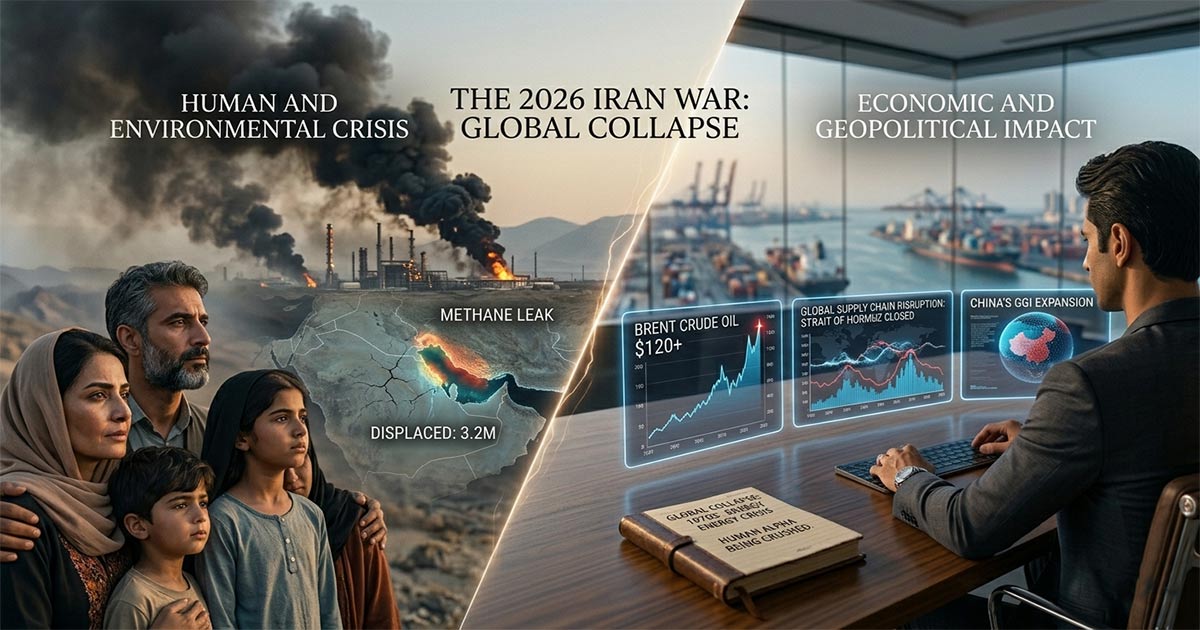
The closure of the Strait of Hormuz on March 4 was the “black swan” event economists feared. With 20% of the world’s oil and LNG supply stranded, the impact has been immediate:
- Brent Crude Surge: Prices spiked past $120 per barrel, with some analysts predicting $150 if the maritime blockade continues.
- Fertilizer Shock: As a hub for petrochemicals, the region’s instability has sent global fertilizer prices up 20%, threatening food security in agricultural giants like India and Thailand.
- Aviation Paralysis: Thousands of flights between Europe and Asia have been grounded or rerouted, causing billions in tourism losses.
2. Environmental Ecocide: Nature as a Casualty
This war is being fought on the world’s most sensitive hydrocarbon zones. The environmental cost in just three weeks has been staggering:
- Methane Leaks: Strikes on the South Pars Gas Field (the world’s largest) have triggered massive, uncontrolled methane leakage a greenhouse gas 30 times more potent than CO2.
- Toxic Plumes: Attacks on the Shahran oil refinery have blanketed Tehran in “poisonous black clouds,” leading to toxic rain that experts fear will cause long-term health crises.
- Carbon Footprint: In the first 14 days alone, the conflict released over 5 million metric tons of CO2 more than the annual output of 84 smaller nations combined.
3. The Geopolitical Pivot: Strategic Space for the East
While the US is bogged down in the Gulf, the global power balance is shifting:
- China’s Calculus: Beijing is facing energy vulnerabilities but is using the “strategic vacuum” to expand its influence through the Global Governance Initiative (GGI).
- The Indo-Pacific Shift: With US assets tied to the Middle East, regional players are watching the South China Sea and Taiwan Strait with renewed concern.
4. The India Factor: Navigating the “Vande Bharat” Crisis 2.0
For India, the 2026 Iran conflict is not a distant war it is a domestic economic emergency. With over 9 million Indian nationals working across the GCC, the Ministry of External Affairs has triggered the largest evacuation protocol since 2020.
Beyond the humanitarian scale, the “energy-food” nexus is under immense strain. India imports nearly 80% of its crude oil, much of it passing through the now-blocked Strait of Hormuz. This has forced the government to dip into Strategic Petroleum Reserves (SPR), while the domestic price of LPG and petrol has hit record highs in March 2026.
Furthermore, the disruption of the International North-South Transport Corridor (INSTC) which connects Mumbai to Chahbahar has frozen millions in trade, forcing India to accelerate its “Strategic Autonomy” and look toward alternative Arctic and terrestrial trade routes to reach European markets.
5. The Common Man: Life in the Crosshairs
Beyond the spreadsheets, the “Human Alpha” we often discuss is being crushed.
- Mass Displacement: Over 3.2 million Iranians are internally displaced. In Lebanon, over 1 million people have fled their homes ahead of ground incursions.
- The Grocery Emergency: GCC states, which rely on the Strait for 80% of their food intake, are facing acute shortages. Staples are being airlifted, leading to 100% price hikes in local markets.
SilverScoop Summary:
The Core Thesis: War in 2026 is no longer “contained.” The digital and physical umbilical cords of the world (Straits, Cables, Satellites) make every local conflict a global trauma.
The Humanity Check: Being “human” in 2026 means recognizing that a drone strike in Bushehr eventually affects the price of bread in Bengaluru and the air quality in Athens.
The Takeaway: We are witnessing the death of “Regime Change from the Skies.” True security can no longer be achieved through kinetic force alone in an interconnected world.
FAQs’
Q: When did the 2026 Iran War begin?
A: Hostilities began on February 28, 2026, with coordinated US and Israeli airstrikes dubbed “Operation Epic Fury.”
Q: Why is the Strait of Hormuz so critical?
A: It is the world’s most important oil chokepoint. Approximately 21 million barrels of oil per day pass through it; its closure has triggered the worst energy disruption since the 1970s.
Q: What is the humanitarian toll so far?
A: As of late March 2026, at least 2,000 people have been killed across Iran, Israel, and Lebanon, with over 3 million displaced in Iran alone.
Q: How is the Iran-US-Israel war affecting fuel prices in India?
A: Due to the blockade of the Strait of Hormuz, global crude prices have surged. In India, this has led to a direct increase in petrol and diesel costs by nearly 15-20% within the first three weeks of March 2026.
Q: Is there an evacuation plan for Indians in the Middle East?
A: Yes, the Indian government has launched a massive maritime and aerial “Vande Bharat” style evacuation to bring home citizens from high-risk zones in Iran, Lebanon, and neighboring Gulf states.
Have any thoughts?
Share your reaction or leave a quick response — we’d love to hear what you think!
-
 1
1
-
 1
1
-
 0
0
-
 0
0
-
 0
0
-
 0
0