

Table of Contents
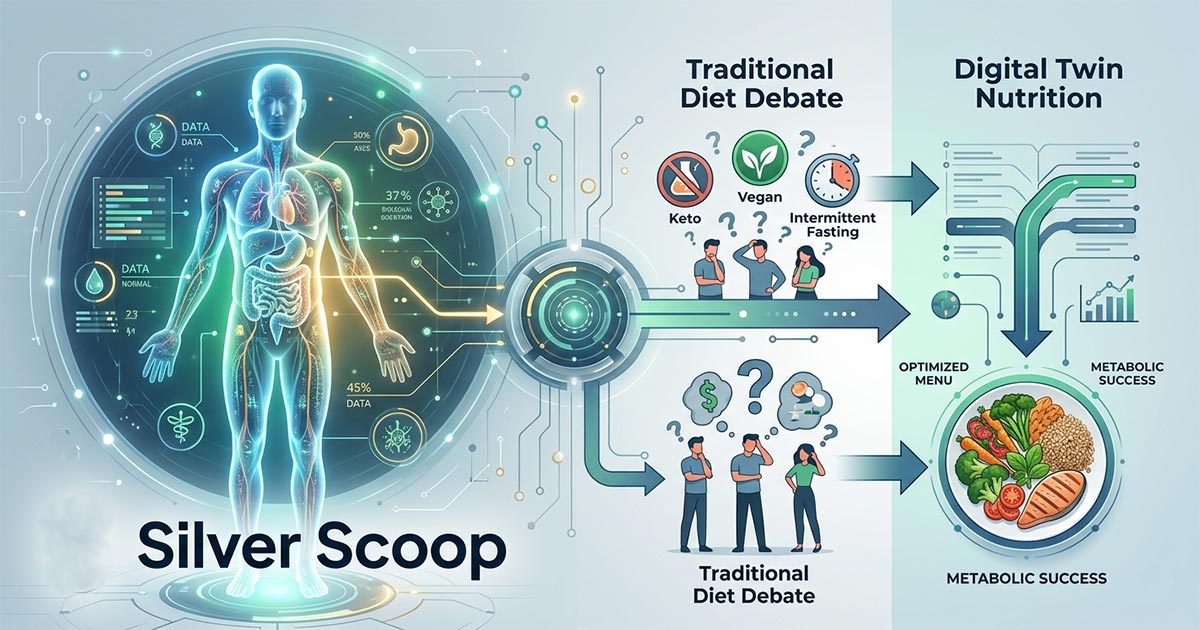
For decades, the world of nutrition has been a battlefield of conflicting ideologies. Keto vs. Vegan, Low-Carb vs. Low-Fat, Intermittent Fasting vs. Small Meals the “Diet Debate” has left most people more confused than nourished.
But as we cross into 2026, the argument is finally being silenced not by a new celebrity diet, but by data.
Welcome to the era of Digital Twin Nutrition. By combining AI-driven “virtual bodies” with real-time metabolic monitoring, we are moving past generic advice and into a world where your biology dictates the menu.
What is a “Digital Twin” in Nutrition?
A Digital Twin is a high-fidelity, virtual model of your unique metabolism. It isn’t just a profile; it’s a dynamic simulation built from:
- Real-time Wearable Data: Continuous Glucose Monitors (CGMs) and metabolic health patches.
- Biological Inputs: Your gut microbiome composition and genetic markers (like the FTO gene).
- Lifestyle Factors: Sleep quality, stress levels (HRV), and physical activity.
The AI uses this data to predict how your “twin” will respond to a specific meal before you even take a bite. It’s the ultimate “What If” machine for your health.
Why Real-Time Monitoring is the “Diet Killer”
The reason diets fail is simple: Biochemical Individuality. Research in 2025 and 2026 has confirmed that two people can eat the exact same sourdough toast, yet one will have a stable energy curve while the other suffers a massive glucose spike and subsequent “crash.”
1. The End of “Good” vs. “Bad” Foods
With real-time metabolic monitoring, foods are no longer labeled “healthy” or “unhealthy” in a vacuum. A banana might be a perfect pre-workout fuel for one person but a metabolic disruptor for another. The “debate” ends when you can see the results on your smartphone in 15 minutes.
2. Immediate Feedback Loop
Traditional dieting relies on the bathroom scale a lagging indicator that takes weeks to move. Digital Twin Nutrition provides instant feedback. When you see a “spike” after a specific dressing or hidden sugar, the behavioral change is immediate and frictionless.
3. Predictive “Meal Testing”
The latest 2026 AI platforms allow you to “test” a restaurant menu through your Digital Twin. You can see which dish will maintain your metabolic flexibility and which will cause an afternoon slump, allowing you to choose the “winner” every time.
Living the “Sattvic” High-Performance Life in Vrindavan
At Silver Scoop Blog, we often discuss the intersection of ancient wisdom and modern tech. In the spiritual and high-energy atmosphere of Vrindavan and Mathura, Digital Twin Nutrition is becoming a tool for Sattvic (pure) living.
- Prana-Focused Eating: Local residents and tech-nomads are using metabolic sensors to ensure their food increases their Prana (life force) rather than causing lethargy.
- The Modern Fast: Instead of rigid fasting windows, people in the Braj region are using real-time data to identify the exact moment their body enters a state of autophagy, making spiritual fasts more scientifically precise.
The 2026 Outlook: Nutrition as Software
The personalized nutrition market is expected to hit $12 billion by 2030, driven largely by the integration of AI and wearables. We are moving toward a future where your kitchen appliances and grocery apps are synced with your Digital Twin.
The Bottom Line: The best diet for you isn’t found in a book or a trending hashtag. It’s written in your real-time metabolic data. Stop debating, start monitoring, and let your Digital Twin lead the way.
FAQs’
1. What is Digital Twin Nutrition?
It is a technology that creates a virtual model of your metabolism using data from wearables (like CGMs), gut health tests, and DNA to predict how you will respond to different foods and lifestyle choices.
2. Do I need a prescription for metabolic monitoring?
As of 2026, many Over-the-Counter (OTC) metabolic sensors and smart patches are available for wellness and performance tracking, though some medical-grade CGMs still require healthcare provider guidance.
3. How does this help with weight loss?
By identifying which specific foods cause insulin spikes in your body, you can stabilize blood sugar, reduce cravings, and improve fat oxidation without the “trial and error” of traditional dieting.
Have any thoughts?
Share your reaction or leave a quick response — we’d love to hear what you think!
-
 1
1
-
 2
2
-
 0
0
-
 0
0
-
 0
0
-
 0
0