


Table of Contents
The landscape of digital publishing in 2026 has reached a definitive turning point. As AI-powered search engines like Gemini and Perplexity prioritize “EEAT” (Experience, Expertise, Authoritativeness, and Trustworthiness), technical SEO is no longer a competitive advantage it is the baseline “table stakes” required just to enter the game.
To win clicks in this high-frequency environment, the modern editorial direction must shift from keyword density to human connectivity. Here is how to master that balance.
1. Technical SEO is the Foundation, Not the Goal
In 2026, search visibility is less about isolated tweaks and more about how your site functions as a strategic ecosystem. Google and other search engines now evaluate entire systems, assuming a baseline of technical quality.
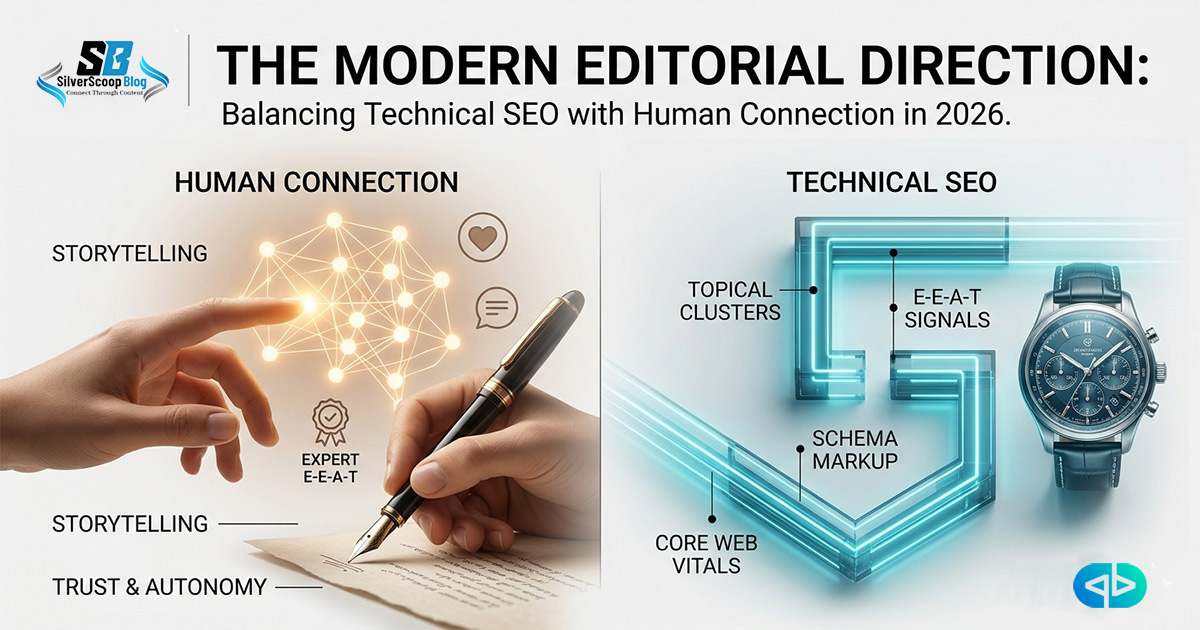
- Systemic Authority: Instead of individual pages, build Topical Clusters. Use pillar pages to define your scope and supporting articles to satisfy specific sub-intents.
- Structured Data as a Bridge: Use Schema Markup (Article, FAQ, and Author schema) not as a shortcut to rank, but as a way to remove uncertainty for AI models, allowing them to extract and cite your data accurately.
- Performance is User Experience: Core Web Vitals (loading speed and mobile usability) are no longer “bonuses” they are essential for user satisfaction and fundamental to staying indexed.
2. The Human Connection: Intent Over Indexing
Algorithms now follow users, not the other way around. If users consistently prefer concise, expert-backed explanations, the search engine will reward that content.
- Satisfy the “Underlying Problem”: Technical SEO can tell you what someone types, but editorial strategy tells you why. Are they looking to act, compare, or research? Align your format whether it’s a comparison table, a quick checklist, or an in-depth guide to that specific intent.
- E-E-A-T is the New Currency: Trust is the most valuable ranking signal in 2026. First-hand insights and original data add a layer of authenticity that AI cannot replicate.
- Write for “Scanning” and “Synthesis”: AI summaries favor content that provides direct, concise answers in the first paragraph. Use logical heading structures (H1, H2, H3) to help both humans and AI navigate your core arguments quickly.
3. High-Click Editorial Tactics for 2026
To maximize your click-through rate (CTR), your editorial must feel like a clear explanation from a peer rather than a technical manual.
- Emotional Title Tags: Titles that speak directly to a user’s pain point (e.g., “How We Cut Costs by 62%”) generate significantly higher CTR than generic, keyword-stuffed alternatives.
- The Power of Perspective: AI provides summaries; humans provide nuance and trade-offs. Address the “missing angles” your competitors are too afraid to touch to build genuine brand authority.
- Multi-Surface Optimization: Search now happens across YouTube, TikTok, and ChatGPT. Ensure your editorial direction includes video resources and conversational FAQs to capture users wherever they are searching.
The Verdict: Refinement Over Expansion
In 2026, publishing more content no longer guarantees results. Success is found in refining existing authority. By embedding trust and authenticity into your technical framework, you future-proof your visibility against the next wave of algorithmic shifts.
Strategy Tip: For a deeper dive into modern content frameworks, check out the resources atLinqBuilder’s Blog, where they break down the technical nuances of building authoritative link structures in an AI-first world.
FAQs’
Q: Why is “Human Connection” a ranking factor in 2026?
A: Search engines have evolved to prioritize user engagement and trust. Technical SEO gets you to the door, but “Human Connection” (measured through time-on-page and low bounce rates) tells AI models that your content actually solves the user’s problem.
Q: Does Technical SEO still matter for small blogs?
A: Absolutely. Technical SEO is your site’s “hygiene.” Without a fast, mobile-optimized, and well-structured foundation like those discussed in LinqBuilder’s technical guides even the most beautiful writing will fail to be indexed.
Q: How do I satisfy AI search agents?
A: AI agents prefer structured, concise answers. Using clear H2 headers and providing a summary “TL;DR” at the beginning of your posts helps these models extract your key points for their users.
Have any thoughts?
Share your reaction or leave a quick response — we’d love to hear what you think!
-
 1
1
-
 2
2
-
 0
0
-
 1
1
-
 0
0
-
 0
0