

Table of Contents
We have all been there: You are deep into an critical task, your momentum is steady, and then seemingly out of nowhere your brain turns into a sponge. Your attention fragments, your eyes feel heavy, and you find yourself staring blankly at a blinking cursor or mindlessly opening a browser tab.
The traditional response? Power through. Grab another espresso, force your focus, and rely on pure discipline to break the wall.
But in 2026, the elite wellness and tech community has realized that “forcing focus” is a biological mistake. Pushing past that mental wall doesn’t prove your discipline; it accumulates cognitive debt. True high performers are abandoning arbitrary time management systems like Pomodoro which interrupts you just as you hit your creative stride and are instead claiming their Cognitive Sovereignty by mastering Ultradian Rhythms.
1. The Neurobiology of Your 90-Minute Brain
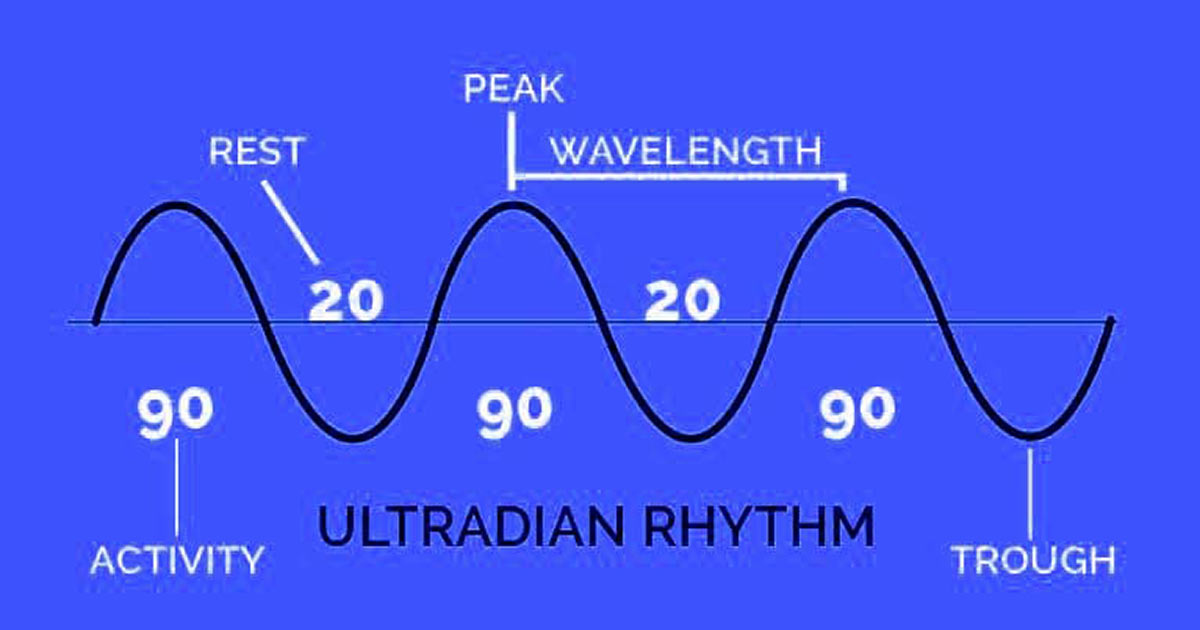
Discovered by pioneering sleep researcher Nathaniel Kleitman, Ultradian Rhythms are biological cycles shorter than 24 hours. While your circadian clock governs your 24-hour sleep-wake cycle, your waking hours are driven by the Basic Rest-Activity Cycle (BRAC).
This hardwired cycle alternates between roughly 90 minutes of heightened alertness and 15 to 20 minutes of a natural energy trough.
[0-15 Min: Warm-up] -> [15-75 Min: Peak Flow] -> [75-90 Min: Fadeout] -> [90-110 Min: Ultradian Trough]
According to Stanford neuroscientist Dr. Andrew Huberman, during the active, 90-minute focus window, your brain relies on a finite reserve of essential neurochemicals specifically acetylcholine for spatial focus and dopamine for steady motivation.
After 90 minutes of intense processing, these chemical reserves begin to drastically deplete. If you continue to force your brain to run hot without a break, your cortisol levels surge, your error rates compound exponentially, and your creative associative thinking completely halts.
2. Focus Fragmentation vs. Biological Sprints
This is exactly why generic 25-minute productivity timers often fail high-level knowledge workers. It takes the human brain roughly 15 minutes just to load context, orient to a complex problem, and filter out digital background noise.
Interrupting yourself with an arbitrary bell at minute 25 fragments your attention right as your neural networks hit their stride.
The Waking Ultradian Signature
- The Active Phase (75–90 Mins): High frontal beta wave activity, suppressed Default Mode Network (DMN), and optimized neurochemical tracking. Perfect for strategic deep work, coding, and writing.
- The Trough Phase (15–20 Mins): Elevated alpha and theta wave activity. The brain shifts inward to consolidate data, clear away metabolic waste byproducts, and rebuild dopamine reserves.
3. The 10-Minute Reset: How to Step into the Trough
To maintain crisp, near-initial performance levels across an entire workday, you must actively honor the biological trough. However, a recovery break does not mean transitioning from your laptop screen to your smartphone screen. Checking emails or scrolling social media engages the exact same prefrontal cortex circuitry that you just exhausted, compounding your mental fatigue.
True neural recovery requires a localized, zero-dopamine circuit-breaker. Enter The 10-Minute Reset. The moment you experience the classic indicators of an ultradian fadeout yawning, restlessness, or physical sighing step away and deploy one of these protocols:
- Non-Sleep Deep Rest (NSDR): Close your eyes, sit back, and perform a simple 10-minute progressive body scan or box-breathing routine. This actively suppresses your sympathetic nervous system (“fight or flight”) and hands control over to your parasympathetic system for accelerated neural repair.
- Optic Flow Alignment: Step completely outside or look out an open window. Intentionally focus on a distant horizon while letting your peripheral vision relax. This naturally unwinds the visual and mental focus mechanisms that tighten up during screen work.
- The Kinesthetic Shift: If you have been completely stationary during your focus sprint, change your environment. Walk briskly for 10 minutes, stretch your shoulders, and hydrate slowly away from your workspace.
4. Structuring an Ultradian-Aligned Workspace
You cannot force yourself to run through five consecutive 90-minute sprint cycles a day; the brain can realistically sustain only 3 to 4 high-quality deep-work blocks before hit with massive diminishing returns.
- Protect Peak One: Your first ultradian cycle after waking up is consistently your strongest due to your natural morning cortisol awakening response. Lock this window down exclusively for critical, creative strategy. No communication channels allowed.
- Use Wavelength Audio: During the active phase, leverage pink noise or specialized neuro-entrainment audio to help lock your brain into stable focus patterns.
- Deploy Analog Anchors: Map out your master goals for each 90-minute block inside a premium physical planner before opening your digital workspace. This ensures you know exactly what singular issue you are resolving.
The Verdict: Manage Your Energy, Not Just Your Hours
In the high-frequency environment of 2026, time management is a superficial metric. True professional longevity is achieved by managing your biological energy currency. By coordinating your schedule with your internal clock, you stop fighting your neurochemistry and unlock a highly sustainable path to clarity.
Sprint hard. Rest completely. Repeat with intent.
FAQs’
Q: Can I drink coffee during my ultradian rest phase to keep going?
A: It is counterproductive. Caffeine artificially overrides the adenosine buildup that signals fatigue, masking your brain’s need to rest and down-regulate. This leads to a severe afternoon crash and fractures your focus during the next active cycle.
Q: How do I handle ultradian troughs if I work in an open office or corporate setting?
A: Use subtle physical cues. Put on noise-canceling headphones to signal a boundary, stand up to grab water, or step outside for a 10-minute walk. Even a brief mental detachment can reset your attention circuits.
Have any thoughts?
Share your reaction or leave a quick response — we’d love to hear what you think!
-
 1
1
-
 1
1
-
 0
0
-
 0
0
-
 0
0
-
 0
0