

Table of Contents
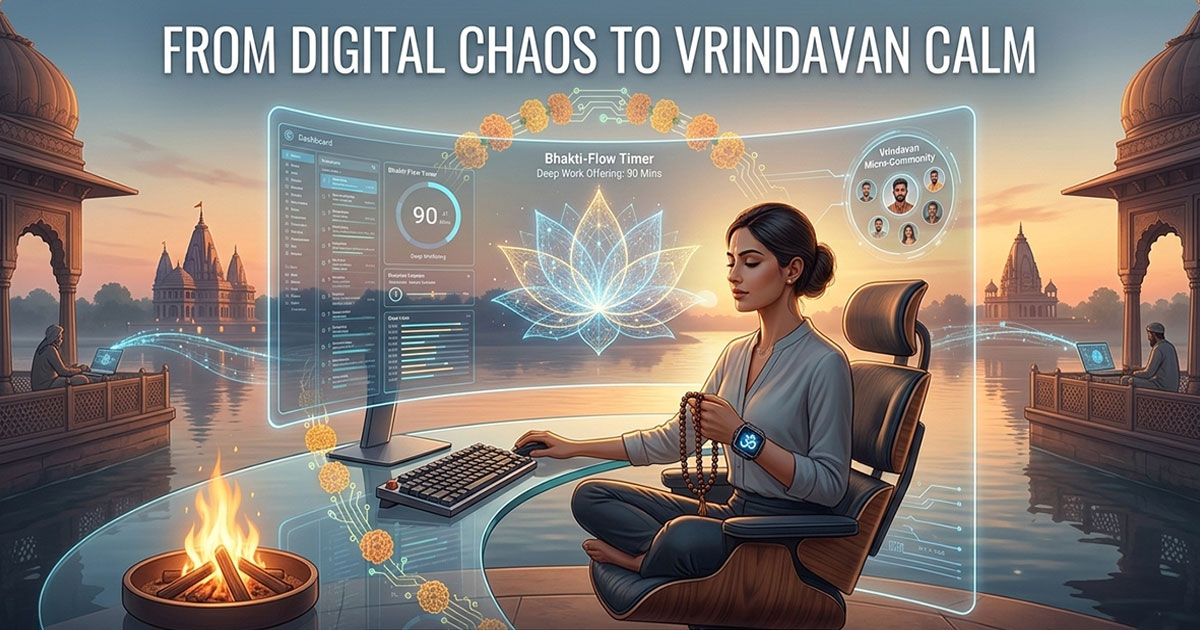
From Digital Chaos to Vrindavan Calm: Applying “Bhakti” Focus to Deep Work
In the hyper-connected world of 2026, our attention is the most contested resource on earth. As founders and creators, we fight a daily war against “Context Switching” and the endless noise of the Big Feed.
Cal Newport gave us the framework for Deep Work, but the ancient streets of Vrindavan have held the secret to “Single-Pointed Focus” for millennia. By shifting from mere concentration to Bhakti-led Devotion, we can transform high-pressure work from a source of burnout into a flow state of transcendental productivity.
The Science of Bhakti: Beyond Simple Mindfulness
While basic mindfulness (Vipassana) focuses on clearing the mind, Bhakti focuses on filling the mind with a singular, beloved object of devotion. In 2026, neuroscientific research from institutions like Stanford has shown that Nama Japa (mantra meditation) and devotional focus activate the Prefrontal Cortex more effectively than passive silence.
- The Vagus Nerve Connection: Chanting and rhythmic devotional breathing have been proven to increase Heart Rate Variability (HRV), lowering cortisol and allowing the brain to enter a “Safe-to-Create” mode.
- The “Flow” of Surrender: In Bhakti, the concept of Sharanagati (surrender) removes the “Performance Anxiety” that kills creativity. When you offer your work to a higher power, the fear of failure vanishes, leaving only the “Skill in Action.”
3 Bhakti Principles to Reclaim Your Deep Work
1. Ishta-Devata for Your Project (The North Star)
In Bhakti, one chooses an Ishta-Devata a cherished form of the divine to focus all love upon.
- The Work Hack: Treat your current project as your Ishta. Stop viewing your “To-Do List” as a burden. Instead, “Consecrate” your deep work block. For these 90 minutes, the code you write or the strategy you build is your highest offering. This shift from “Task” to “Offering” eliminates the friction of procrastination.
2. Kirtan-State Productivity (The Rhythmic Flow)
Vrindavan is never silent; it vibrates with the rhythm of Kirtan. This constant, melodic repetition creates a “Shared Frequency.”
- The Work Hack: Use Binaural Beats or Lofi-Mantra loops to create an auditory “sanctuary.” Just as the bells of the Banke Bihari temple signal a transition in the day, use specific sounds to “anchor” your brain into deep focus. When the music starts, your brain knows: The world is out, the work is in.
3. Seva-Led Ambition (The Purpose Pivot)
The most successful startups of 2026 aren’t chasing exits; they are performing Seva (selfless service).
- The Work Hack: When you feel the “Digital Chaos” rising, pause and ask: “Who does this work serve?” By pivoting your focus from “My Revenue” to “Their Value,” you tap into a secondary reserve of biological energy. This is the Vrindavan Edge where ambition is fueled by compassion, not just competition.
The Vrindavan Lab: A 2026 Case Study
We are seeing a new wave of “Spiritual Nomads” moving to the Braj region. These aren’t backpackers; they are AI engineers and FinTech founders who have realized that the high-vibration environment of Vrindavan acts as a natural “Deep Work” incubator.
They aren’t escaping the world; they are plugging into a more stable power source.
The Verdict: Your Work is Your Worship
The transition from Digital Chaos to Vrindavan Calm isn’t about moving to India; it’s about moving your focus from the “Self” to the “Service.” In the era of AI and automation, your ability to apply Bhakti Focus to your craft is the only thing that remains truly human.
Recommended Reading: The Spiritual Techie: Why Vrindavan is the New Cure for Startup Burnout: https://silverscoopblog.com/spiritual-techie-vrindavan-wisdom-startup-burnout/
Ready to start your first Bhakti-led Deep Work session? Tell us in the comments: What project are you “consecrating” today?
FAQs
Q: Can I practice Bhakti focus if I’m not religious?
A: Yes. Bhakti, in a productivity context, is about the psychology of devotion. It’s about choosing a “Higher Purpose” for your work and using rhythmic rituals to maintain focus.
Q: How does Bhakti differ from standard Mindfulness?
A: Mindfulness is often about detaching from thoughts. Bhakti is about attaching your thoughts to a single, meaningful focus, which is often more effective for high-intensity cognitive tasks.
Q: What is a “Digital Sunset” in Vrindavan?
A: It’s a practice used by many Braj-based nomads where all digital screens are turned off at twilight (Sandhya), replaced by physical rituals or nature walks to reset the circadian rhythm.
Have any thoughts?
Share your reaction or leave a quick response — we’d love to hear what you think!
-
 0
0
-
 0
0
-
 0
0
-
 0
0
-
 0
0
-
 0
0