
Table of Contents
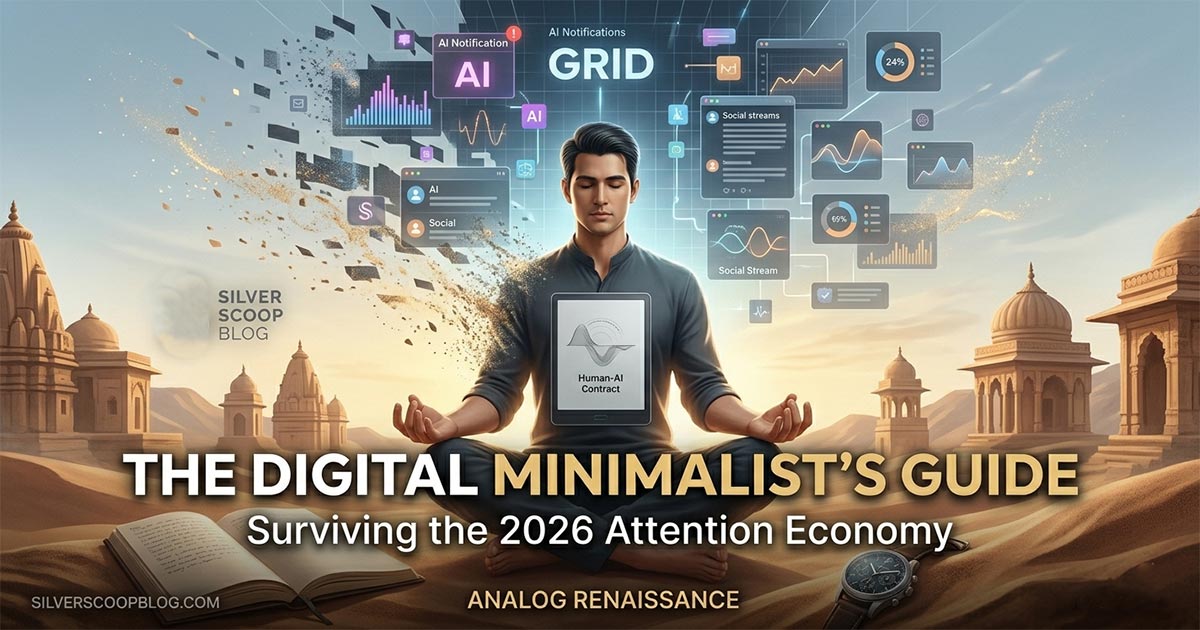
In 2026, we no longer “go online.” We live inside the network. With the proliferation of ambient computing where your glasses, your watch, and even your home’s walls are constantly “listening” to serve you AI-driven suggestions silence has become the ultimate luxury.
The Attention Economy has evolved. It is no longer just about clicking an ad; it is about harvesting your “Cognitive Surplus.” If you aren’t careful, every spare second of your day will be optimized by an algorithm.
Read more on Attention Is Currency: The Business Model of Distraction – https://silverscoopblog.com/attention-is-currency-business-model-of-distraction/
Here is the Silver Scoop guide to reclaiming your focus and surviving the most distracted era in human history.
1. The “Dumbphone” as a Status Symbol
The most significant trend of the Analog Renaissance (read more on The Analog Status Symbol – Why Disconnectedness is the new trend?) is the rejection of the “All-in-One” device. In 2026, carrying a high-end, minimalist E-ink device or a classic Nokia-style “dumbphone” isn’t a sign of being tech-illiterate; it’s a sign of Cognitive Sovereignty.
- The Logic: By stripping away the 6G-enabled notifications, you remove the “Always-On” trigger.
- The Social Shift: High-performers are increasingly using “Dumbphones” for their personal lives and keeping their AI-heavy spatial headsets strictly for their Circadian Tasking windows (as we discussed in our Circadian Tasking deep-dive).
2. Opt-Out of Ambient Suggestions
2026 hardware is designed to be “proactive.” Your fridge suggests recipes; your car suggests routes; your AI agent suggests who to email.
- The Minimalist Hack: Turn off Predictive Agentic AI.
- Why it works: When an AI predicts your next move, it bypasses your prefrontal cortex. To maintain a sharp mind, you must intentionally re-introduce “Friction.” Choose your own music. Type your own emails. Navigate your own streets.
3. The “Analog Buffer” Rule
Digital minimalism in 2026 isn’t about moving to a cave; it’s about Compartmentalization.
- The Protocol: For every hour spent in a spatial computing environment or interacting with an AI agent, you must spend 20 minutes in an Analog Buffer. * Activities: Physical book reading, manual handwriting (The “Bhubaneswar Ledger” style), or a quick walk. This allows your nervous system to “down-regulate” from the high-frequency stimulations of the Invisible Internet.
4. Curating Your “Physical AI”
As we explored in our Domestic Robotics analysis, technology should be a servant, not a roommate.
- The Goal: Use Physical AI (like cleaning bots) to automate the labor so you can reclaim the thought. * The Trap: Avoid “Social Robots” or AI companions that mimic human interaction. These are the ultimate attention-drainers, designed to keep you emotionally tethered to a subscription model.
5. The Vrindavan Protocol: Seasonal Resets
The most effective way to survive the 2026 Attention Economy is to exit it entirely at regular intervals.
- The Practice: The 48-Hour Digital Fast. * The Inspiration: Taking a page from the Vrindavan Parikrama, a seasonal “Optic Flow” reset where you move through a physical environment without a single sensor on your body is the only way to “hard-reboot” your dopamine baselines.
The Digital Minimalist’s 2026 Toolkit
- E-Ink Tablet: For focused reading and writing without blue-light or notifications.
- Mechanical Watch: Reclaim time from your wrist without the “Heart Rate” anxiety.
- Physical Map: Re-learn the spatial layout of your city (Bhubaneswar is perfect for this!).
- Analog Journal: The only “cloud-free” storage for your most sensitive ideas.
The Verdict: Attention is Sovereignty
In the 2026 Attention Economy, those who can sit in a room alone for an hour without a digital stimulant will be the ones who lead the next decade. Minimalism isn’t about having less; it’s about being more.
Reclaim your mind. Start the Renaissance today.
FAQs’
Q: What is the Attention Economy?
A: It is a business model where a consumer’s attention is treated as a scarce commodity. In 2026, this involves AI agents competing to predict and capture your every cognitive moment.
Q: Can I be a Digital Minimalist and still work in Tech?
A: Absolutely. In fact, many 2026 SaaS founders (see our Reverse Migration post) use Digital Minimalism to protect their focus for high-level coding and strategy.
Q: What is the Analog Renaissance?
A: It is a 2026 cultural movement favoring physical experiences, tactile goods, and disconnected time as a response to the over-saturation of AI and ambient computing.
Have any thoughts?
Share your reaction or leave a quick response — we’d love to hear what you think!
-
 1
1
-
 2
2
-
 0
0
-
 0
0
-
 0
0
-
 0
0