

Table of Contents
In the venture capital circles of 2026, the term “Embodied AI” is no longer a buzzword it’s the new gold rush. But while the world watches viral videos of Tesla’s Optimus or Boston Dynamics’ Atlas doing backflips, the real money is moving toward a more “grounded” reality.
The first breakout unicorn in the Physical AI space won’t be a general-purpose humanoid that can fold laundry and play chess. It will be a specialized Autonomous Cleaning Agent. Here is why the boring task of floor maintenance is the launchpad for the next trillion-dollar robotics industry.
1. The “Data Moat”: Cleaning is the Ultimate Trainer
To build a successful AI, you need data. To build a successful Physical AI, you need interaction data with the messy, unpredictable real world.
- The Reality: Unlike factory floors, human homes are chaotic. Shoes move, pets shed, and sunlight shifts.
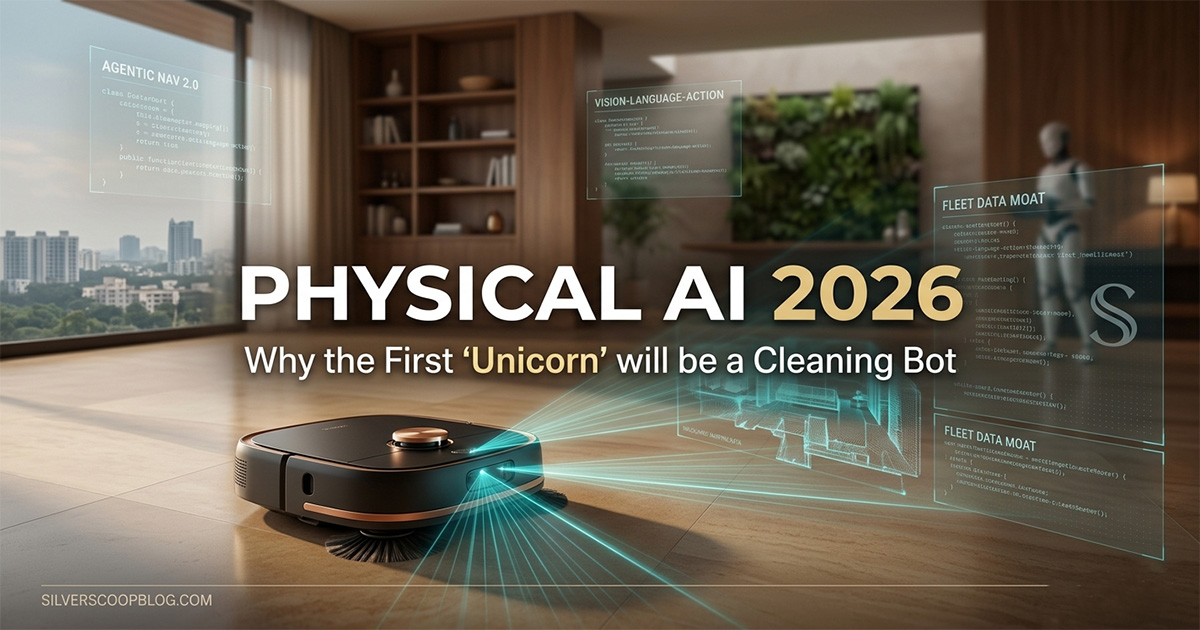
- The Opportunity: Cleaning bots are the only robots currently invited into millions of homes daily. In 2026, companies like Gausium and Dreametech are using this “Fleet Data” to train models on how to navigate tight spaces and identify textures (e.g., distinguishing between a spilled latte and a tangled 6G cable). This data is a “Moat” that humanoid startups can’t easily replicate.
- Read an article on Yamuna river Cleanup with Robotics – https://silverscoopblog.com/yamuna-cleaning-robotics-startups-2026/
2. From “Bump-and-Run” to Agentic AI
The 2026 generation of robots has moved beyond simple “path planning.” We are now in the era of Agentic Cleaning.
- Spot Detection 2.0: Using VLA (Vision-Language-Action) models, a 2026 bot doesn’t just clean a room; it inspects it. If it sees a coffee stain, it doesn’t just vacuum over it; it switches to a localized “Deep Scrub” mode, handles the mess, and then resumes its route.
- Human-Intent Following: Thanks to Natural Language Processing, you no longer need an app. You simply point and say, “Clean up the dirt by the mudroom,” and the bot’s Physical AI translates that command into a spatial coordinate instantly.
3. The “Unicorn” Metrics: High Frequency, High Pain
Venture capitalists look for High-Frequency Pain Points. * The Math: Cooking is a choice; cleaning is a constant. In 2026, dual-income households spend an average of 11 hours a week on floor maintenance.
- The ROI: A “Physical AI” cleaning bot that requires zero human intervention (self-emptying, self-washing, and self-drying) offers an immediate 300% ROI in terms of “Time Wealth” for the user. This is a much easier “sell” than a $30,000 humanoid that is still learning how to hold a cup.
4. Hardware Miniaturization & The “Bhubaneswar Blueprint”
Following our Silver Scoop focus on Tier-2 tech hubs, cities like Bhubaneswar and Coimbatore are becoming hubs for “Component Optimization.”
- The Shift: By localizing the production of high-precision Solid-State LiDAR and magnesium-alloy chassis, Indian robotics startups are driving the cost of high-end Physical AI down to the “iPhone range” (₹80,000–₹1,20,000).
- The Player to Watch: Keep an eye on the preorder rollout of 1X Technologies’ NEO Beta. While it is a humanoid, its primary “Market Entry” task is home cleaning and tidying proving that even the “General Purpose” players know where the money is.
5. The “Analog Renaissance” Connection
Even in our “Analog Renaissance” (where we value digital-free time), we still want the results of technology.
- The Paradox: We want to be unreachable on our “dumbphones” in Vrindavan, but we want to return to a house that has been scrubbed to a 99.9% hygiene standard by an invisible AI.
- The Result: The cleaning bot is the ultimate “Invisible Tech” it serves the Analog lifestyle without intruding on it.
- Read our post on Digital Fast in Vrindavan in Vrindavan
The Verdict: Bet on the Bot with the Brush
The first Physical AI unicorn will be born in the dust. While humanoids are the “Future of Labor,” cleaning bots are the “Present of Profit.” In 2026, the cleaning bot is no longer a gadget; it is the first true AI Resident in the global home.
FAQs’
Q: What is Physical AI?
A: Physical AI (or Embodied AI) refers to artificial intelligence systems that have a physical body and can interact with, move through, and change their physical environment in real-time.
Q: Why are cleaning robots considered the leaders in this space?
A: Because they have the largest existing dataset of human home environments and a clear, high-frequency use case that justifies the cost of advanced sensors and AI models.
Q: Are 2026 cleaning bots better than 2024 models?
A: Significantly. 2026 models use Generative Physical AI to learn new floor types and obstacles on the fly, rather than relying on pre-programmed maps.
Have any thoughts?
Share your reaction or leave a quick response — we’d love to hear what you think!
-
 0
0
-
 2
2
-
 0
0
-
 0
0
-
 0
0
-
 0
0