
For years, the “4-Hour Deep Work” block was the gold standard of productivity. We were told that if we could just lock ourselves in a room for four hours, we’d conquer the world.
But as we move through 2026, a glaring flaw has emerged: Time is not a flat circle. A 10:00 AM hour is not the same as a 2:00 PM hour. One is fueled by a cortisol peak; the other is a battle against a post-prandial glucose dip.
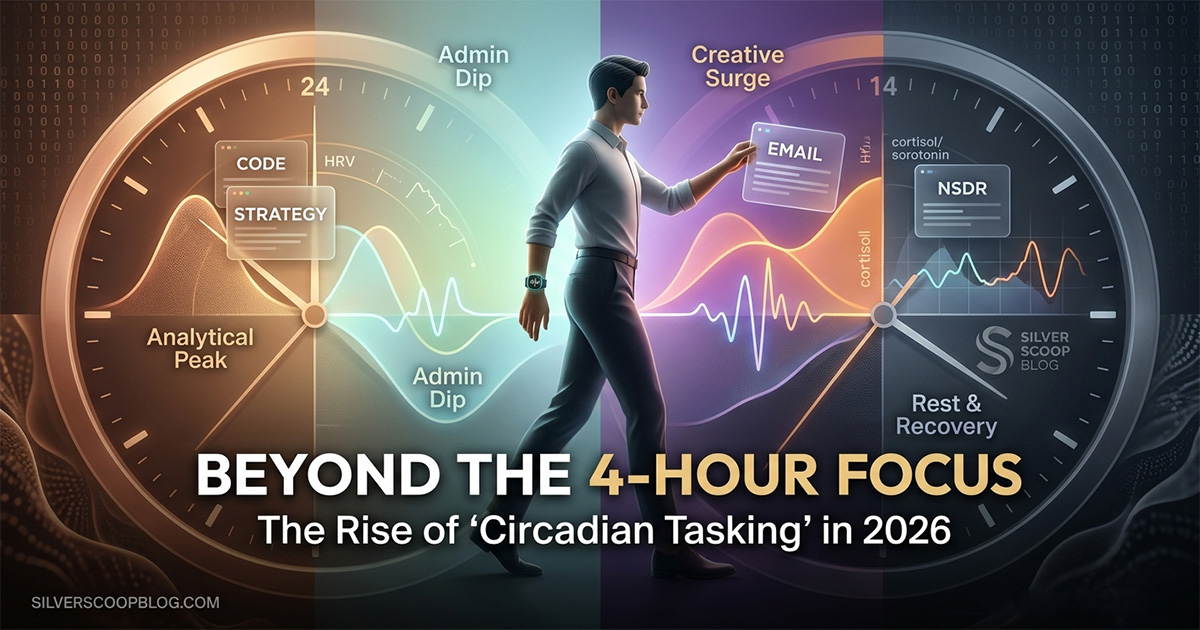
The most successful founders and creators have moved beyond “Time Management” into Circadian Tasking. This is the art of matching the cognitive load of a task to the biological state of the body. Here is why the 9-to-5 is dead, and how to build your 2026 schedule around your cells.
1. The Science: Why “Time” is an Illusion
Our bodies are governed by the Suprachiasmatic Nucleus (SCN), a master clock that regulates everything from body temperature to cognitive speed.
- The 2026 Shift: We no longer guess our “Prime Time.” With 2026 wearables providing real-time Heart Rate Variability (HRV) and core temperature data, we can see exactly when our “Neural Window” opens.
- The Trend: High-performers are now “stacking” tasks based on hormone cycles rather than calendar availability.
2. Phase 1: The Cortisol Climb (The Analytical Peak)
For the majority of “Larks” (and even many “Owls” after their first waking hour), the morning is dominated by rising cortisol and body temperature.
- The Task: Logical Heavy Lifting. This is the time for coding, financial modeling, or technical SEO audits (the “Bhubaneswar Blueprint” style work).
- The Circadian Hack: Do not waste this “Clean Logic” window on emails or Slack. In 2026, “Emailing before 11:00 AM” is considered a productivity sin.
3. Phase 2: The Post-Prandial Dip (The “Admin” Zone)
Between 1:00 PM and 3:00 PM, most humans experience a natural dip in alertness.
- The Task: Low-Cognitive Administrative Work. This is your window for meetings, expense reporting, or routine social media scheduling.
- The Reset: This is also the prime window for Non-Sleep Deep Rest (NSDR) or a “Digital Fast” walk (as we explored in our Vrindavan Parikrama post).
4. Phase 3: The Serotonin Surge (The Creative Insight)
As body temperature peaks again in the late afternoon, the brain enters a “Loose Association” state.
- The Task: Creative Strategy & Ideation. Because the “Editor” in your brain is slightly tired, you are more likely to make lateral connections. This is when you should be brainstorming your “Human-AI Contract” series or mapping out new SaaS features.
- The 2026 Advantage: Using spatial computing tools during this window allows for “Visual Thinking” that matches the brain’s creative fluidity.
5. Integrating HRV: The “Pitch or Pivot” Metric
Following the Silver Scoop philosophy of data-backed decisions, 2026 productivity is non-linear.
- The HRV Rule: If your wearable shows a suppressed HRV (indicating high systemic stress or poor recovery), Circadian Tasking dictates that you pivot.
- The Play: Swap a high-stakes “Analytical Peak” for an “Active Recovery” day. Forcing a cortisol-heavy task on a low-HRV body leads to burnout and “Technical Debt” in your work.
How to Implement “Circadian Tasking” This Week
- Identify Your Chronotype: Use a 2026 biometric app to track your core temperature peaks for three days.
- Audit Your Tasks: Categorize your work into High Logic, High Creative, and Low Cognitive.
- The “Buffer” Protocol: Leave 30 minutes between circadian phases. Your brain needs an “Analog Buffer” to switch from the high-focus cortisol state to the collaborative serotonin state.
The Verdict: Bio-Logical Productivity
The “4-Hour Focus” was a step in the right direction, but Circadian Tasking is the destination. By 2027, the most productive people won’t be those who work the longest, but those who work the most accurately within their biological windows.
Stop fighting your body. Start tasking with it.
Recommended Reading: The 4-Hour Focus Window: Why 8-Hour Workdays are Biologically Inefficient and How to Master “Deep Work” – https://silverscoopblog.com/4-hour-focus-window-deep-work-productivity/
FAQs’
Q: What is Circadian Tasking?
A: Circadian Tasking is a productivity methodology where work tasks are scheduled based on an individual’s biological rhythms (hormone levels, body temperature, and HRV) rather than a standard clock.
Q: Is it different from Deep Work?
A: Yes. Deep Work focuses on how you work (without distraction); Circadian Tasking focuses on when you perform specific types of work to match your brain’s natural readiness.
Q: How do I know my biological prime time?
A: You can track this using 2026 wearables that monitor Heart Rate Variability (HRV) and sleep-wake cycles, or by observing your natural energy peaks over a 72-hour period.
Have any thoughts?
Share your reaction or leave a quick response — we’d love to hear what you think!
-
 2
2
-
 2
2
-
 0
0
-
 0
0
-
 0
0
-
 0
0