

Table of Contents
The Silver Spotlight: The Nuclear Waste “Librarians”
The Startup: Deep Isolation
The Boring Problem: Global nuclear waste management (the ultimate “can kicked down the road”).
The Silver Solution: Borrowing directional drilling from the oil & gas industry to bury waste horizontally beneath stable rock.
The Billion-Dollar “Can” We Can’t Stop Kicking
For sixty years, the nuclear energy debate has been trapped in a circular argument. Proponents point to carbon-free baseload power; critics point to the glowing piles of spent fuel sitting in “temporary” pools and dry casks on the surface.
The problem isn’t that we don’t know how to store it we know deep geological disposal is the answer. The problem is scale and optics.
Traditional solutions involve “Mined Repositories” (think Yucca Mountain). These are massive, multi-billion dollar construction projects that require carving out cathedrals in the rock. They take decades to build, face endless political gridlock, and nobody absolutely nobody wants one in their ZIP code.
Enter the “Boring” Solution.
The Pivot: From Mining to Drilling
Deep Isolation, a Berkeley-based startup, looked at the problem and asked a very “SilverScoop” question: Why are we trying to build a hotel for waste when we could just drill a borehole?
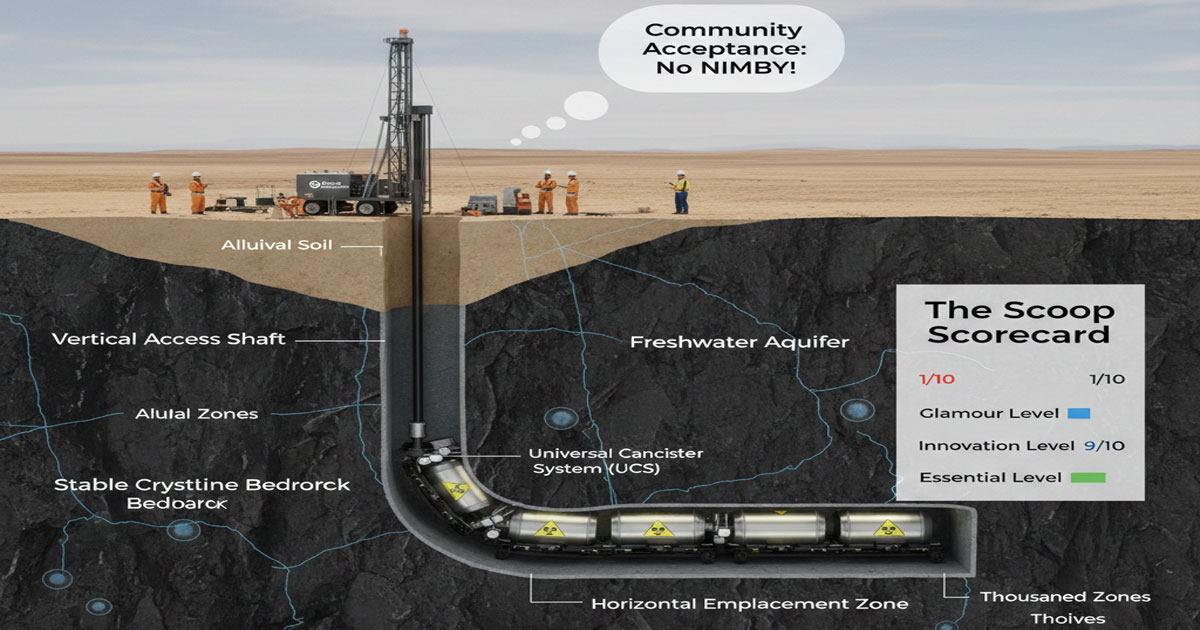
Instead of a giant mine, Deep Isolation uses directional drilling. This is the same mature, “boring” technology the oil and gas industry has used for decades to reach shale gas.
How it Works
- The Vertical Drop: They drill a narrow hole (about 9–13 inches wide) straight down, thousands of feet past the water table.
- The “Kick-off”: Using directional tech, the drill gradually curves until it is nearly horizontal.
- The Gallery: The waste is placed in corrosion-resistant, “Universal Canisters” end-to-end in this horizontal section, miles away from any human contact or moving water.
The 2026 Update: From Theory to Groundbreaking
As of February 2026, this isn’t just a white paper. Deep Isolation recently launched its Full-Scale Demonstration Program in Cameron, Texas. In collaboration with giants like Halliburton, they are currently proving at depth that these canisters can be placed and retrieved with surgical precision.
Why This is a “Silver” Masterstroke
At SilverScoop blog (SSB), we look for Social Arbitrage. Deep Isolation is a perfect example for three reasons:
- Modular Growth: Unlike a mined repository that requires a $50B upfront investment, boreholes are modular. A small country or a single power plant can drill one borehole at a time as needed.
- The “NIMBY” Antidote: Because the footprint on the surface is just a standard drill rig (which disappears once the hole is sealed), the “visual” impact is nearly zero. It’s much easier to get community consent for a hole in the ground than a massive mining complex.
- Future-Proofing: Their Universal Canister System (UCS) is designed to handle waste from “Legacy” reactors and the new “Advanced” SMRs (Small Modular Reactors) we keep hearing about.
The SilverScoop Blog (SSB) Scorecard
- Glamour Level: 1/10 (It is literally burying trash in the mud).
- Innovation Level: 9/10 (Applying “Old Tech” to a “New Crisis”).
- Essential Level: 10/10 (Without a waste solution, the Green Energy transition stalls).
Recommended Readings: The Social Arbitrage Playbook: Build a Global Brand from Vrindavan | Top Indian Clean Tech & Agritech Startups 2026: Funding & Tier-3 Opportunities | The Rise of Social Arbitrage: Why Personal Brands are the Decade’s Highest-Yield Asset Class
The Bottom Line
Deep Isolation is the “Librarian” of the nuclear world. They aren’t trying to make nuclear energy “cool”; they are making it organized and permanent.
By taking a boring, established technology (drilling) and applying it to the world’s most “stuck” problem, they might have just unlocked the path to a truly carbon-free 2030.
What do you think? Is “Deep Borehole” disposal the final piece of the climate puzzle, or is it just another way to sweep the problem under the rug (literally)? Let us know in the comments.
FAQs
Q: Is horizontal borehole disposal actually safe?
A: Yes. By placing waste thousands of feet below the surface in stable, “crystalline” bedrock far below the water table the waste is isolated from the biosphere for millions of years, mimicking natural mineral deposits.
Q: How is this different from traditional “nuclear dumps”?
A: Traditional repositories like Yucca Mountain are massive, expensive mining projects. Deep Isolation uses modular, narrow boreholes that can be drilled locally at power plants, reducing the need for dangerous long-distance transport.
Q: Can the waste be retrieved later?
A: Surprisingly, yes. The Universal Canister System (UCS) is designed so that the waste can be pulled back up if future generations decide to recycle it for newer reactor types.
Have any thoughts?
Share your reaction or leave a quick response — we’d love to hear what you think!
-
 0
0
-
 0
0
-
 0
0
-
 0
0
-
 0
0
-
 0
0